
What Mercury Retrograde Actually Means
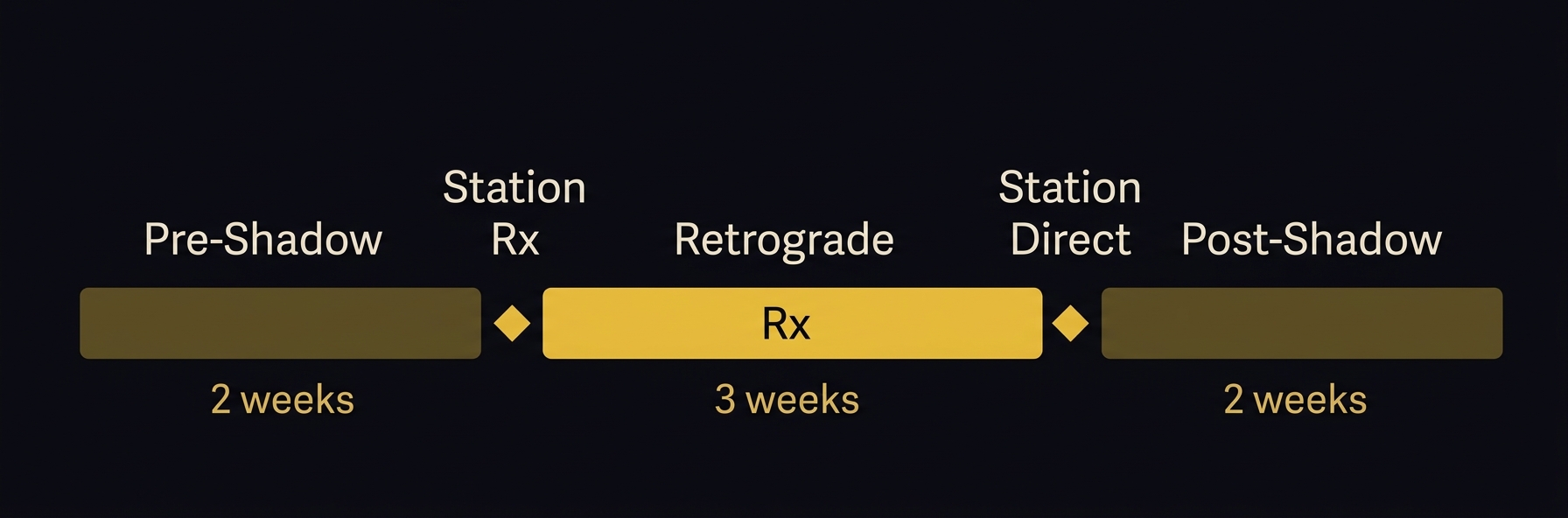
Mercury doesn't literally reverse its orbit. What happens is an optical illusion caused by relative orbital speeds. Mercury orbits the Sun faster than Earth does. When it laps us — passing between Earth and the Sun — it appears from our perspective to slow down, stop (the "station"), and then move backward through the zodiac. After about three weeks it stations again and resumes direct motion.
Astronomers call this apparent retrograde motion. It's the same effect you see when you pass a slower car on the highway — for a moment, the other car seems to drift backward relative to your window. Nothing has changed about the car's actual direction. The geometry of your vantage point creates the illusion.
Astrologically, Mercury rules communication, contracts, cognition, short-distance travel, technology, and the processing of information. When it retrogrades, those domains don't break — they shift into review mode. The forward momentum that normally drives Mercury-ruled activities pauses. Things that were moving fast get slowed down. Details you skipped over resurface. Conversations you thought were finished reopen.
The retrograde period also includes a "shadow" phase — roughly two weeks before and after the retrograde proper — where Mercury covers the same degrees it will retrace. Effects tend to build during the pre-shadow and taper during the post-shadow. The station days (when Mercury appears to stop before changing direction) are typically the most intense.
Every retrograde happens in a specific sign and set of houses in your natal chart. Natal Mercury retrograde in Gemini hits differently than Mercury retrograde in Capricorn. The sign colors the flavor; the house tells you which area of life gets the review notice. Generic "Mercury retrograde" advice misses this entirely — what matters is where it lands in your chart.
Effects on Communication: Contracts, Conversations, and the Ex Factor
Mercury retrograde's most famous effect is communication breakdown, and this one has teeth. During the retrograde period, the gap between what you mean and what lands on the other end widens measurably. Emails get misread. Texts arrive out of order or context. You say one thing and the person across from you hears something else entirely. This isn't cosmic punishment — it's Mercury-ruled processing running in reverse, which means incoming information gets filtered through old patterns rather than fresh comprehension.
Contracts signed during Mercury retrograde have a higher-than-average rate of renegotiation. Not because the contract is cursed, but because retrograde conditions make it harder to catch ambiguous language, missing clauses, or assumptions that haven't been spoken aloud. If you must sign during a retrograde, read everything twice. Then read it again. Have someone else read it. The extra diligence costs nothing and catches what retrograde fog obscures.
The "ex comes back" phenomenon is real, but it's not romantic destiny — it's Mercury's review function applied to relationships. Retrogrades surface unfinished business. If a conversation was left incomplete, a boundary was never set, or closure was skipped in favor of a clean exit, retrograde creates the conditions for that loop to reopen. Whether you engage or not is your call. The transit creates the opportunity; it doesn't make the decision.
Negotiations and important discussions benefit from extra clarity during this period. Say what you mean with more precision than usual. Confirm receipt. Follow up verbal agreements in writing. Assume nothing was understood the first time. These habits are good practice regardless, but they become load-bearing during Mercury retrograde.
Arguments that start during retrograde often stem from old grievances wearing new costumes. Before you react to what someone said today, check whether your intensity actually belongs to something that happened six months ago. Retrograde has a way of dressing old wounds in current clothing.
Effects on Technology and Travel
Mercury rules systems of transmission and transport. During retrograde, those systems develop an uncanny tendency to glitch. Your phone freezes. The Wi-Fi drops during the most important call. Flight delays stack. GPS routes you through a neighborhood that no longer exists. This isn't superstition — enough people track these patterns that the correlation holds, whatever your preferred explanation.
Technology issues during retrograde cluster around data loss, miscommunication between systems, and devices that were already on their last legs finally giving out. Mercury retrograde doesn't curse your new laptop. It does seem to accelerate the timeline on hardware and software that was already failing. Think of it as a stress test: anything running on borrowed time gets exposed.
Travel delays are the other signature. Short-distance travel — commutes, regional flights, train schedules — tends to be more disrupted than long-haul trips (those fall more under Jupiter's domain). Layovers get extended. Bags get routed to the wrong city. Rental car reservations vanish from the system. None of this is inevitable, but the probability shifts enough to warrant buffer time.
Practical countermeasures actually work here. Back up your devices before the retrograde starts. Save your work obsessively. Arrive at the airport early. Build an extra day into tight travel timelines. Keep receipts and confirmation numbers accessible instead of buried in email. These aren't rituals — they're reasonable responses to a period where logistical friction increases.
Software launches and website migrations are worth delaying if the timeline allows. Not because the code will be cursed, but because the retrograde environment makes it harder to catch bugs in testing, and user-facing communication around launches (documentation, announcements, onboarding) is more likely to confuse than clarify.
The Practical Survival Guide
Mercury retrograde doesn't require you to stop living your life. It requires you to shift how you engage with Mercury-ruled activities. Think of it as switching from draft mode to edit mode. The forward momentum pauses so you can review, revise, and catch what you missed the first time through.
Back up everything. Your phone, your laptop, your important documents. Do this before the retrograde starts. Cloud storage, external drive, whatever your method — just do it. The twenty minutes this takes can save you from genuine disaster.
Re-read before you send. Emails, texts, contracts, proposals. Read them once for content and once for tone. Mercury retrograde amplifies the gap between intention and reception. What sounds clear in your head may land very differently on the other end.
Delay signing if you can. If a contract or major agreement can wait three weeks, let it wait. If it can't wait — because life doesn't pause for planetary transits — proceed with extra scrutiny. Get a second set of eyes on the language. Clarify every assumption in writing.
Build in buffer time. Add thirty minutes to your commute. Book an extra day before important meetings. Don't schedule back-to-back flights with tight layovers. Retrograde rewards slack in the system and punishes tight margins.
Expect delays, don't create them. The retrograde slows things down on its own — your job isn't to add to the friction by procrastinating or avoiding action entirely. Show up on time, do your work, but hold space for the fact that other people and systems may not cooperate on your preferred schedule.
Use the review function. This is actually Mercury retrograde's gift, and most people ignore it. The transit is structurally designed for revision. Edit the manuscript. Revisit the business plan. Rework the budget. Reconnect with people you've lost touch with. The "re-" prefix is your friend during retrograde: review, revise, reconsider, reconnect, reorganize.
Don't make retrograde your excuse. Mercury retrograde lasts roughly three weeks, happens three times per year (occasionally four, depending on the calendar year). That's nearly a quarter of your year. If you put your life on hold every retrograde, you're not being astrologically savvy — you're using the planets as a reason not to act. The point is awareness, not paralysis.
Myths That Need to Die
Myth: Mercury retrograde causes bad things to happen. Mercury retrograde doesn't cause anything. It describes a period where certain types of activities — communication, technology, logistics — require more attention than usual. The "bad things" that happen during retrograde are usually the result of moving at direct-motion speed during a retrograde-motion period. You're running the wrong program for the current conditions.
Myth: You shouldn't start anything new during retrograde. This gets repeated so often it's become astrological doctrine, but it's an oversimplification. You shouldn't start things that depend entirely on clear communication, flawless technology, and perfect timing — because those conditions are less available during retrograde. But creative projects, research, revisiting old ideas, and picking up abandoned work? Retrograde is actually ideal for those.
Myth: Mercury retrograde affects everyone the same way. It doesn't. The impact depends on where the retrograde falls in your natal chart, whether it aspects your natal Mercury, and which sign it's moving through. Someone with natal Mercury in Virgo will experience a retrograde in Virgo very differently than someone with natal Mercury in Sagittarius. Blanket advice about retrograde ignores the chart entirely, which is like giving everyone the same prescription regardless of their symptoms.
Myth: Mercury retrograde is the worst transit in astrology. Not even close. Saturn oppositions, Pluto squares, and eclipses on sensitive points carry far more structural weight than any Mercury retrograde. Mercury retrograde is inconvenient. Those transits are transformative. The outsized fear around retrograde is a product of internet astrology amplifying the most meme-able transit, not a reflection of its actual astrological weight.
Myth: Mercury retrograde is always negative. The retrograde period is genuinely useful for anyone willing to work with its rhythm. Some of the best creative breakthroughs happen during retrograde, because the normal forward momentum stops and you're forced to look at what's already there with fresh eyes. Editors, researchers, archivists, and revisers of all kinds often do their best work when Mercury stations retrograde. The problem isn't the transit — it's the insistence on doing direct-motion work during a retrograde-motion period.
Related: Saturn Return — the transit that restructures your life
Frequently Asked Questions
- How often does Mercury go retrograde?
- Mercury retrogrades three times per year (occasionally four, depending on the calendar year), with each retrograde lasting approximately three weeks. Including the shadow periods before and after, the full cycle runs about eight weeks. This means Mercury spends roughly a quarter of each year in some phase of retrograde activity.
- Can I sign a contract during Mercury retrograde?
- You can, but proceed with extra caution. Read every clause carefully, clarify ambiguous language in writing, and have a second person review the terms. Contracts signed during retrograde have a higher rate of renegotiation — not because they're cursed, but because the conditions make it easier to miss details. If the timeline allows a delay, waiting until Mercury goes direct is the lower-friction choice.
- Why does my ex always text during Mercury retrograde?
- Mercury retrograde surfaces unfinished business, and incomplete relationship conversations qualify. The transit creates conditions where old communication loops want to close. Your ex isn't being cosmically compelled to text you — but the retrograde environment lowers the threshold for revisiting things that were left unresolved. Whether you respond is entirely your decision.
- Does Mercury retrograde affect all zodiac signs equally?
- No. The impact depends on which sign Mercury retrogrades through, which house that sign occupies in your natal chart, and whether the retrograde makes aspects to your natal planets. Someone with Mercury-ruled placements (Gemini or Virgo rising, natal Mercury in a prominent position) tends to feel retrogrades more strongly than someone whose chart emphasizes other planets.
- Is Mercury retrograde a good time to start a new business?
- It's not ideal for launches that depend on flawless communication, clean logistics, and first impressions landing perfectly — because those are exactly the areas retrograde disrupts. However, it's an excellent time to revisit a business plan, rework your strategy, reconnect with old contacts, or revive a shelved idea. The distinction is between starting fresh and refining what exists.
- When is the next Mercury retrograde?
- Mercury retrograde dates shift each year. Check an ephemeris or a reliable astrology calendar for the current year's retrograde periods. Pay attention to which zodiac sign the retrograde occurs in — that tells you far more about its flavor than the dates alone. The sign determines the themes; the dates determine the timeline.