What Moon in Taurus Means
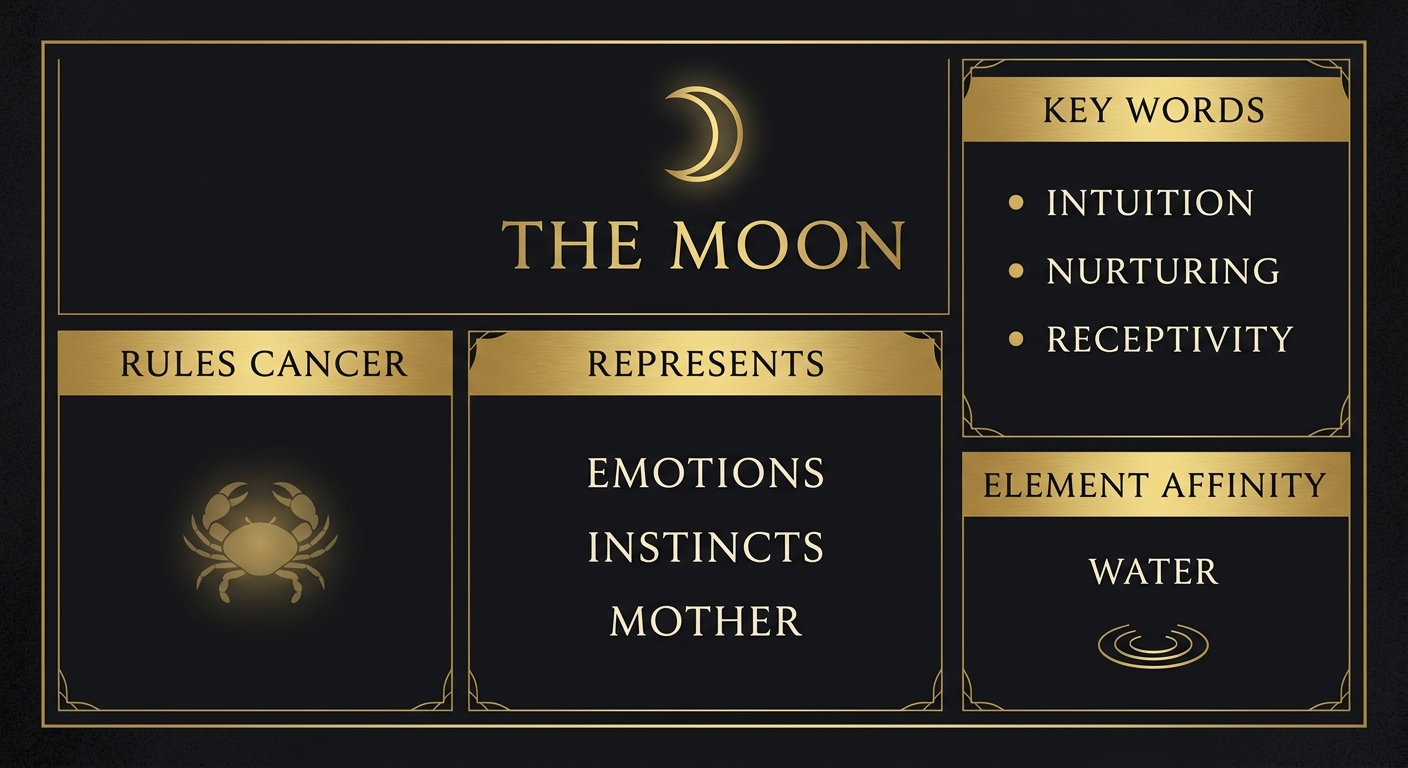
The Moon represents your emotional instincts — the part of you that existed before logic, before language, before you learned how to perform for the world. It is your security blueprint, the unconscious pattern that governs what makes you feel safe and what sends you into quiet panic.
With the Moon in Taurus, your security needs are rooted in the physical world. You need to eat well, sleep well, and live in a space that feels good to your body. A comfortable bed, a well-stocked kitchen, a bank account with a buffer — these are not luxuries for you. They are emotional necessities. When your physical environment is unstable, your emotional life follows.
Taurus is the Moon's exaltation in traditional astrology, which means the Moon functions with unusual steadiness here. Your emotions do not spike and crash. They build slowly, settle deeply, and change only when there is a genuine, sustained reason to shift. This gives you remarkable emotional endurance — but it also means you can hold onto feelings, situations, and people long after the expiration date has passed.
Emotional Patterns & Needs
Moon in Taurus processes emotions through the body and through time. You do not talk yourself out of feelings — you wait them out. Grief, anger, joy, anxiety: all of them move through you slowly, like weather systems. You may not cry the day something happens. You might cry three weeks later, alone, when your body finally decides it is safe to let go.
What triggers comfort: routine, physical touch, familiar foods, nature, financial security, music, soft textures, silence. What triggers distress: sudden changes, being rushed into decisions, financial instability, environments that are loud or chaotic, and anyone who tries to force you to "just get over it."
You have a deep stubbornness that is often misread as rigidity. It is not. It is your nervous system's way of protecting itself. Change is not inherently bad for you — but surprise change, forced change, change without your consent — that registers as a threat. You need to come to things in your own time, at your own pace.
Your emotional default is patience, but when that patience finally runs out, the result is seismic. People who mistake your steadiness for passivity discover that a Taurus Moon pushed past its limit does not argue — it leaves. And once you leave, you do not come back.
Moon in Taurus in Relationships
In love, Moon in Taurus is devoted, physically affectionate, and deeply loyal — but only when it feels earned. You do not give yourself to someone quickly. Trust is built through consistency: showing up on time, following through on promises, being the same person on Tuesday that you were on Saturday. Grand gestures mean less to you than reliable presence.
You show love through tangible acts. Cooking for someone. Building something for their home. Remembering their favorite wine. Your love language is rooted in the material world because that is where you feel safest expressing vulnerability.
What you need from a partner is stability and sensory compatibility. You need someone whose physical presence calms your nervous system — whose voice, whose touch, whose smell registers as home. Partners who run hot and cold, who disappear and reappear, who thrive on drama, will exhaust you at a cellular level.
The challenge for Moon in Taurus in relationships is possessiveness. When you love someone, they become part of your landscape — and you resist changes to your landscape. Learning that a partner's independence is not a threat to your security is essential work for this placement.
Famous Moon in Taurus Examples
Meryl Streep has her Moon in Taurus, and her career reflects the placement perfectly: slow-building, deeply committed, sensory. She does not chase trends. She inhabits roles physically, immersing herself in accent, posture, and detail — all Taurus Moon territory.
Carl Jung had a Taurus Moon, and his entire psychological framework centered on what lies beneath the surface, given time and patience to emerge. His work with archetypes and the collective unconscious mirrors the Taurus Moon's relationship with slow, deep, embodied knowing.
Mick Jagger's Moon in Taurus grounds what might otherwise be a purely Leonine performance style. The physicality of his stage presence, his decades-long commitment to the same band, his shrewd financial instincts — all of it points back to that earthy lunar placement providing a reliable foundation beneath the spectacle.
What these figures share: endurance. Taurus Moon people do not peak and fade. They build something real, tend it carefully, and outlast nearly everyone around them.
Your Moon in Taurus
A 2-3 sentence reading drawn from your actual chart data, generated once and saved to your profile.
Moon Through the 6 Systems
How each ancient system sees this archetype
The emotional body, instinct, and the nervous-system template inherited from your earliest caregivers. The Moon describes how you self-soothe and what it feels like to feel safe.
Chandra — arguably the most important graha in Jyotish. Your rashi (Moon sign) is considered more defining than your Sun sign. Ruler of Cancer, exalted in Taurus. Governs manas (the mind) and mother.
The Moon is the drive — the motivator of your Design. Its activations move you unconsciously day to day, and its transits trigger the body's emotional and somatic rhythms.
In the 64 Archetypes framework, your Moon's hexagram holds the emotional pattern inherited through the maternal lineage — the feeling-body through which love first reaches you.
The Moon placement in your chart resonates with your Mercury Card — the card of close nurturers, family patterning, and the emotional inner circle that shapes your daily rhythm.
The Moon resonates with the number 2 — pairing, receptivity, emotional intelligence. Your Moon phase at birth also colors your Birth Day number and its expression.
Frequently Asked Questions
- What does the Moon sign reveal in a birth chart?
- Your Moon sign describes your emotional instincts — how you react before you think, what makes you feel safe, and what your inner life actually looks like beneath the personality you show the world. It is your emotional blueprint.
- How does the Moon sign affect emotions and mood?
- The Moon governs your emotional rhythms, your comfort needs, and your gut reactions. Its sign shapes what triggers you, how you process difficult feelings, and what you reach for instinctively when you need to restore equilibrium.
- Is the Moon sign more important than the Sun sign?
- Neither is more important — they describe different dimensions of you. The Sun is your conscious identity and direction; the Moon is your inner world and emotional foundation. Both are essential for understanding the full chart.
- How do I find my Moon sign?
- Your Moon sign requires your birth date, birth time, and birth location, because the Moon moves through a new zodiac sign every two to two-and-a-half days. Without an accurate birth time, the Moon's sign can't be confirmed with certainty.