The Generational Signature: 1970–1984
Neptune entered Sagittarius in 1970, and organized religion’s monopoly on spiritual truth began to dissolve almost immediately. The early years of this transit saw the rise of new religious movements—some genuine, many exploitative. The Hare Krishna movement, Transcendental Meditation, and dozens of guru-led communities attracted seekers who had rejected their parents’ churches but not their need for something sacred. Sagittarius seeks truth; Neptune dissolves the boundaries that keep truths separate.
Global travel became spiritualized. The “hippie trail” from Europe to India and Nepal turned geography into theology—the farther you traveled from home, the closer you got to enlightenment. This was also the era when martial arts films and Eastern philosophy entered Western popular culture on a mass scale. Bruce Lee was not just a fighter; he was a Sagittarian philosopher-hero filtered through Neptune’s mystique.
The shadow side was spiritual gullibility. Jonestown (1978) was Neptune in Sagittarius at its darkest: a community that followed a charismatic teacher’s vision of utopia to a literal dead end. The line between genuine wisdom teacher and dangerous cult leader dissolved, and the generation born under this transit carries an instinct for spiritual seeking that is both their greatest gift and their most persistent vulnerability.
Neptune in Sagittarius in Your Birth Chart
If Neptune in Sagittarius sits in your natal chart, the house it occupies shows where your search for meaning is most active—and most susceptible to illusion. In the 9th house (Sagittarius’s natural domain), you are a natural theologian and philosopher, drawn to big questions and comprehensive worldviews. But you may also adopt belief systems uncritically, mistaking enthusiasm for understanding. In the 3rd house, your everyday communication carries a philosophical or spiritual undertone; you teach even in casual conversation.
Aspects to Jupiter (Sagittarius’s ruler) expand the picture. Neptune conjunct Jupiter produces an enormous capacity for faith—you believe deeply and broadly, and your optimism can be genuinely inspiring. But a hard square from Neptune to Jupiter can inflate spiritual claims beyond what reality supports; you may promise more than you can deliver, or follow teachers who do the same.
The house placement personalizes what is otherwise a shared generational trait. Neptune in Sagittarius in the 7th house means your partnerships tend to revolve around shared beliefs—you need a partner who shares your worldview, or at least your commitment to having one. In the 2nd house, you may earn through teaching, publishing, or spiritual services, but financial planning can feel like it contradicts your faith that the universe will provide. Your chart shows where seeking serves you—and where it becomes a way to avoid arriving.
Historical Cycles and Spiritual Legacy
The previous Neptune-in-Sagittarius transit (roughly 1806–1820) coincided with the Second Great Awakening in America—a wave of religious revival that dissolved denominational boundaries and produced new movements like the Latter-Day Saints, the Adventists, and the early Pentecostals. The American frontier was not just a geographical territory; it was a spiritual one, and Neptune in Sagittarius turned every itinerant preacher into a potential prophet.
Further back, the transit around 1643–1657 overlapped with the English Civil War and the explosion of radical Protestant sects—Ranters, Diggers, Levellers, Quakers—each claiming direct access to divine truth without institutional mediation. When Neptune dissolves Sagittarius’s religious structures, the result is not atheism but proliferation: more truths, more teachers, more competing claims to ultimate meaning.
The 1970–1984 generation’s legacy is a spiritual marketplace that the previous century would not recognize. Meditation apps, ayahuasca retreats, astrology’s mainstream resurgence, interfaith dialogue—all bear the fingerprints of Neptune in Sagittarius. Your chart reveals which house holds this placement and where your own search for meaning carries its deepest promise—and its most seductive illusions.
Your Neptune in Sagittarius
A 2-3 sentence reading drawn from your actual chart data, generated once and saved to your profile.
Neptune Through the 6 Systems
How each ancient system sees this archetype
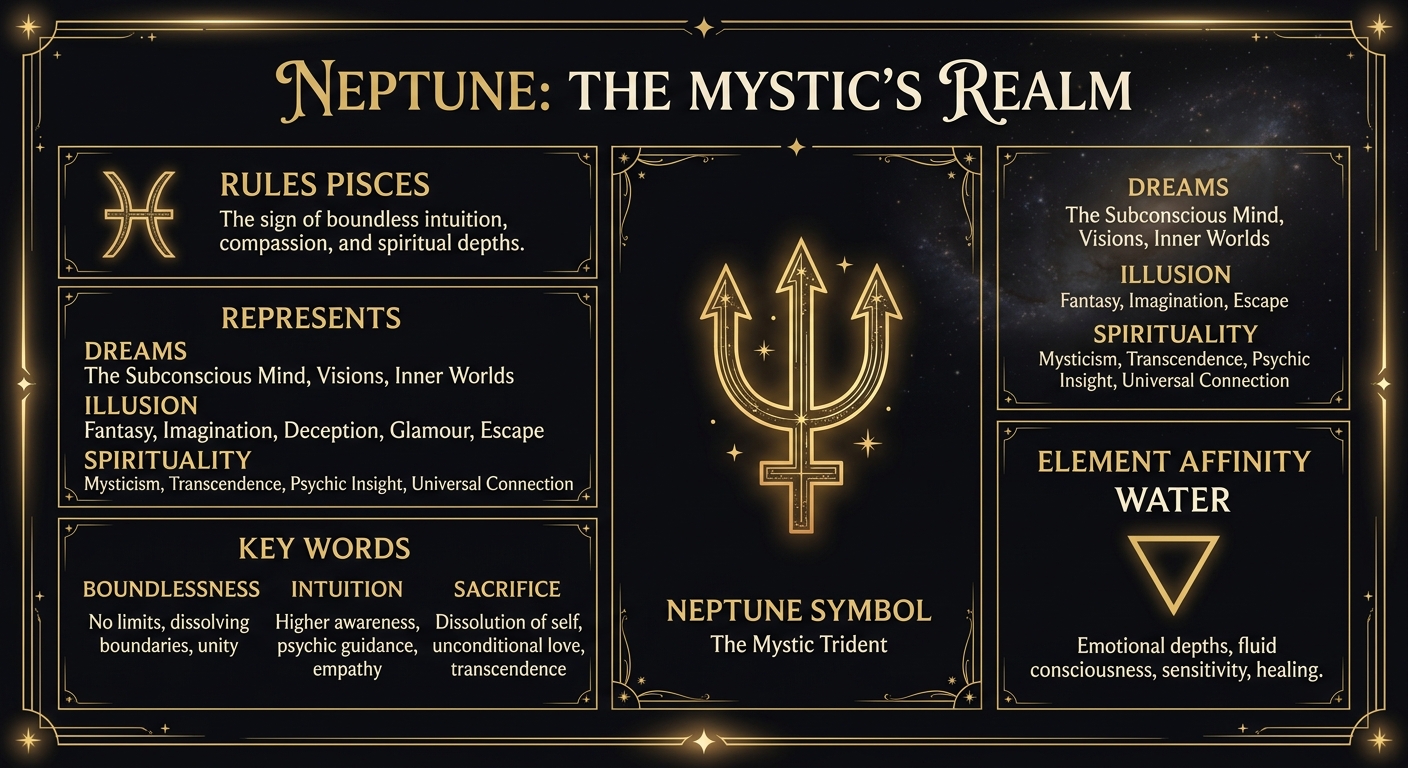
Dissolution, imagination, and the transpersonal. Neptune is the solvent — the principle that thins the boundary between self and source, and opens the artist's and mystic's channels.
Traditional Jyotish attributes Neptune's themes to Ketu (the South Node) — the dissolving graha of moksha, spiritual surrender, and the falling-away of worldly identity.
Neptune moves slowly through the bodygraph; its generational transits carry the collective fog-and-awakening themes that each cohort must see through for real clarity.
In the 64 Archetypes framework, Neptune's generational hexagram carries the dissolving current — the subtle-body layer where individual pattern meets the transpersonal field.
Neptune in Cardology shows up in the deep cycle spreads — the slow tides that shape a generation's romantic ideals, spiritual longings, and creative myths.
Neptune resonates with Master Number 22 (the Master Builder of the unseen) and with Life Path 7 at its most mystical. The principle of transcendent imagination.
Frequently Asked Questions
- What does Neptune's sign reveal in a birth chart?
- Neptune's sign describes the collective ideals, illusions, and spiritual currents of your generation. In your personal chart, Neptune's house and aspects to personal planets reveal where you are most susceptible to dissolving boundaries — and where your intuition and imagination are deepest.
- How does Neptune sign affect intuition and imagination?
- Neptune dissolves the sharp edges of whatever it touches, opening space for imagination, empathy, and spiritual perception. Its sign describes the domain where your generation sought transcendence — and where you personally are most capable of profound sensitivity and most vulnerable to self-deception.
- How long does Neptune stay in each sign?
- Neptune spends approximately fourteen years in each zodiac sign, taking roughly 165 years to complete a full cycle. No living person experiences a Neptune return, which is why it operates almost entirely as a generational signature — made personal only through house placement and aspects.
- Does Neptune sign affect spiritual development?
- Neptune's sign describes the style and framework through which your generation pursues spiritual experience. Whether that takes the form of religious devotion, artistic transcendence, psychedelic exploration, or collective compassion depends on the sign — and on the rest of your chart.