
The Generational Signature: 1937–1958
Pluto entered Leo around 1937—and within four years, humanity had split the atom. The atomic bomb was the definitive Pluto-in-Leo artifact: godlike creative/destructive power concentrated in a single device, wielded by individual leaders who decided the fate of cities with a word. Hiroshima and Nagasaki were Pluto in Leo at its most terrible: the self’s power to destroy made absolute.
The Baby Boom that followed the war was the regenerative side of the same coin. An entire generation was born in a burst of procreative optimism—Leo’s creative drive supercharged by Pluto’s compulsive intensity. This generation would grow up to dominate every stage: political, cultural, economic, and personal. They did not just participate in culture; they insisted on being its center.
The cult of celebrity intensified during this transit. Hollywood’s studio system produced stars who were not merely famous but archetypal—Marilyn Monroe, James Dean, Marlon Brando embodied Pluto-in-Leo energy: magnetic, dangerous, impossible to look away from, and frequently destroyed by the intensity of their own power.
Pluto in Leo in Your Birth Chart
Natal Pluto in Leo gives you a relationship with personal power that is both your greatest resource and your greatest test. You carry an intensity that others feel immediately—a presence that commands attention whether you seek it or not. The house placement shows where that power concentrates.
In the 5th house (Leo’s natural domain), your creative and romantic life carries Plutonian stakes—you do not dabble in art or love; you are consumed by them, and they transform you. In the 1st house, your identity itself has undergone death-and-rebirth cycles; you are not the same person you were a decade ago, and you will not be the same person a decade hence.
Sun aspects to Pluto in Leo define the core dynamic. A conjunction makes you a natural authority figure—people either follow you or oppose you, but no one ignores you. A square creates power struggles with other authority figures (particularly fathers and bosses) that repeat until you claim your own sovereignty without needing to defeat anyone else’s. The transformation Pluto in Leo demands is the death of ego-as-identity and the birth of genuine self-authority.
Historical Cycles and What Comes Next
The prior Pluto-in-Leo transit (1693–1711) saw the consolidation of absolute monarchy in Europe—Louis XIV’s Versailles was the ultimate Pluto-in-Leo expression: an individual sovereign whose personal power was the state itself. “L’état, c’est moi” is Pluto in Leo in four words.
The pattern is consistent: every Pluto-in-Leo cycle asks who holds the power, and whether individual authority serves or devours the collective. The answer is always both—and the tension between creation and destruction, service and self-aggrandizement, is the placement’s permanent condition.
The next Pluto-in-Leo transit arrives approximately 2183–2205. The Boomer generation’s legacy—nuclear power, global media, the cult of the individual—will have been fully absorbed and transformed by then. If you carry Pluto in Leo natally, your chart shows where personal power still demands your attention, still insists on transformation, and still asks whether you will use it to create or to consume.
Your Pluto in Leo
A 2-3 sentence reading drawn from your actual chart data, generated once and saved to your profile.
Pluto Through the 6 Systems
How each ancient system sees this archetype
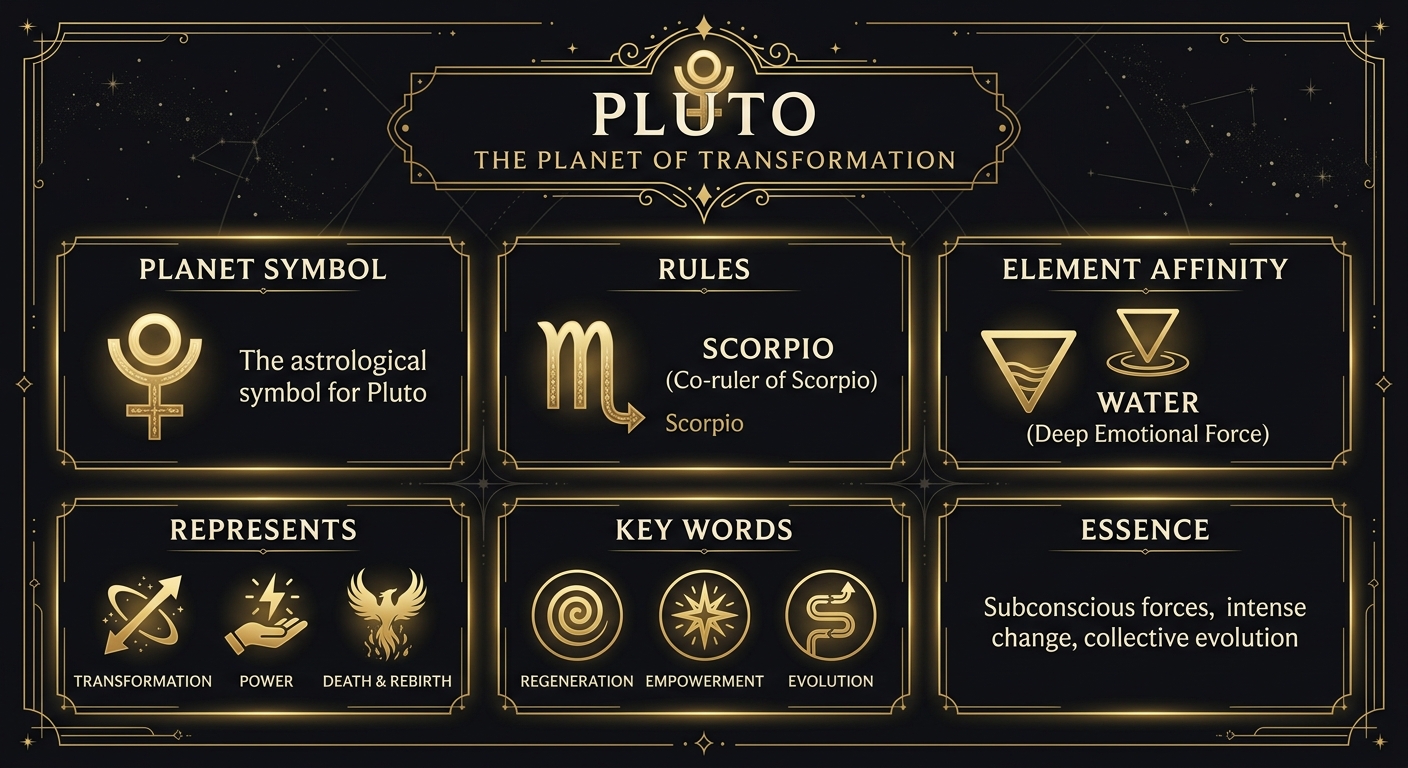
Transformation, power, and the underworld. Pluto is the generational pressure that destroys what cannot evolve — and returns what remains to a deeper, truer form.
Traditional Jyotish attributes Pluto's themes to Mangala (Mars) in its most tamasic form, and to the Rahu-Ketu axis — the karmic compulsion to transform through depth encounters.
Pluto's 12-to-30-year transits through each sign define the deepest generational conditioning. Pluto in the bodygraph marks the collective shadow themes your cohort came to transmute.
In the 64 Archetypes framework, Pluto's generational hexagram holds the deepest ancestral pattern — the transpersonal wound that eventually transfigures into collective gift.
Pluto's long transits mark the death-rebirth cycles in the lifetime spread — the moments when a card position empties out so a new configuration can emerge.
Pluto resonates with Master Number 33 (sacrificial transformation) and with the number 8 at its most alchemical. The principle of death and resurrection.
Frequently Asked Questions
- What does Pluto's sign reveal in a birth chart?
- Pluto's sign describes the generational arena of deep transformation, power struggle, and irreversible change. In your personal chart, Pluto's house and aspects reveal where that collective pressure for transformation is most personally felt — where you encounter intensity, compulsion, and the need to shed what no longer serves.
- How does Pluto sign affect transformation and power?
- Pluto's sign shows the domain where your generation dismantles and rebuilds. In personal placements, it reveals where you are capable of profound depth and regeneration — and where you are most likely to encounter control, obsession, or the kind of loss that fundamentally changes who you are.
- How long does Pluto stay in each sign?
- Pluto spends between twelve and thirty years in each zodiac sign due to its elliptical orbit, taking approximately 248 years to complete a full cycle. It is the slowest-moving planet and functions almost entirely as a generational force — except where it aspects your personal planets directly.
- What does a Pluto transit to a personal planet mean?
- When Pluto transits your natal Sun, Moon, Venus, Mars, or Mercury, it puts that part of your chart through a process of deep excavation. What felt fixed becomes subject to transformation. These transits are slow, intense, and usually irreversible in their effects — but what survives them tends to be more real than what preceded them.