
The Generational Signature: 1983–1995
Pluto entered Scorpio in 1983. The AIDS epidemic was the transit’s defining crisis: a disease transmitted through sex and blood (Scorpio’s domain) that killed with Plutonian relentlessness and forced an entire civilization to confront mortality, sexuality, and the body’s vulnerability simultaneously. The generation born during this transit inherited that confrontation at a cellular level—they carry an awareness of death and desire as intertwined forces that previous generations kept separated.
The fall of the Soviet Union (1991) demonstrated Pluto in Scorpio’s geopolitical expression: hidden rot finally reaching the surface, imperial power collapsing from internal decay rather than external assault. The lesson was profound: the most dangerous power is the kind that operates invisibly, and the most dramatic collapses happen to systems that refuse to acknowledge what is dying inside them.
The rise of the internet during the tail end of this transit gave the generation its defining tool: a technology that exposes the hidden, connects the isolated, and makes surveillance and liberation simultaneously possible. Pluto in Scorpio’s generation was born to operate in the space between transparency and secrecy—and they are still defining that space for the rest of civilization.
Pluto in Scorpio in Your Birth Chart
Natal Pluto in Scorpio is the most intense generational placement in modern astrology. You carry transformative power at a depth that most people find either magnetic or threatening—often both at once. The house placement shows where that depth concentrates.
In the 8th house (Scorpio’s natural domain), your relationship with shared resources, intimacy, and death is profoundly transformative. You may have experienced loss early, or you carry an awareness of mortality that gives you a seriousness others your age do not share. Intimacy for you is not recreation; it is an act of mutual psychological transformation. In the 1st house, you project an intensity that precedes you into every room—people sense your presence before they see you.
Because Pluto rules Scorpio, there is no friction in this placement—the energy flows without obstruction. The challenge is integration. Pluto in Scorpio can become obsessive, controlling, or self-destructive if the intensity has no constructive outlet. The rest of your chart—especially aspects from Saturn, Jupiter, and the luminaries—provides the structure and direction this placement needs to transform rather than consume.
Historical Cycles and What Comes Next
The prior Pluto-in-Scorpio transit (1735–1747) saw the early Industrial Revolution’s darkest foundations being laid: the expansion of the Atlantic slave trade to its peak volume, the consolidation of colonial mining operations that extracted wealth from colonized peoples with lethal efficiency. Scorpio rules other people’s resources; Pluto in Scorpio takes them with no regard for the human cost.
Each Pluto-in-Scorpio cycle forces a civilization to look at the power structures it has built in the dark. The generation born during the most recent transit is doing exactly that: exposing institutional abuse, questioning financial systems built on hidden exploitation, and insisting that what happens in the shadows be brought to light.
The next Pluto-in-Scorpio transit arrives approximately 2237–2254. The millennial generation will be long gone by then, but the systems they build—or fail to build—from their awareness of hidden power will determine what that future generation inherits. Your chart shows where Pluto in Scorpio sits and therefore where your most transformative, most intense, and most essential work is being done.
Your Pluto in Scorpio
A 2-3 sentence reading drawn from your actual chart data, generated once and saved to your profile.
Pluto Through the 6 Systems
How each ancient system sees this archetype
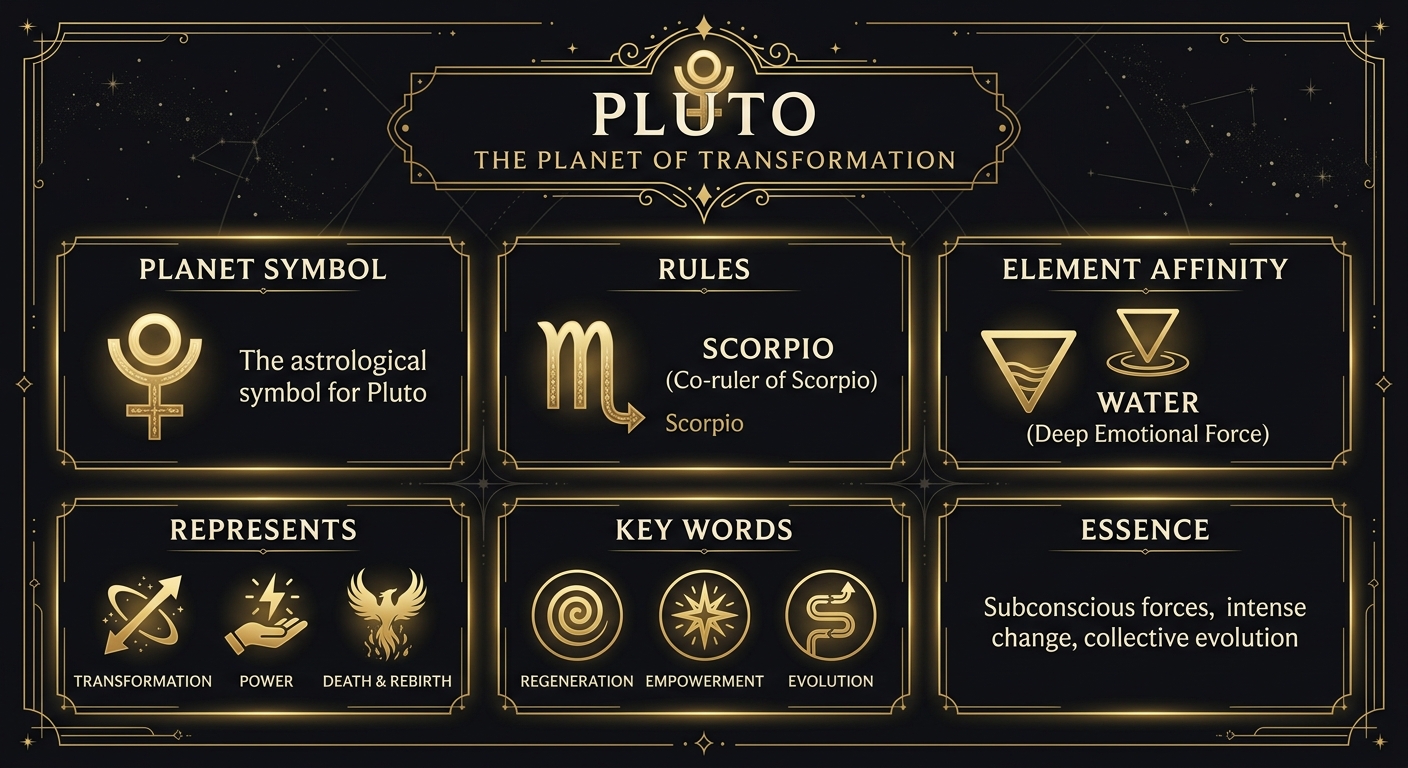
Transformation, power, and the underworld. Pluto is the generational pressure that destroys what cannot evolve — and returns what remains to a deeper, truer form.
Traditional Jyotish attributes Pluto's themes to Mangala (Mars) in its most tamasic form, and to the Rahu-Ketu axis — the karmic compulsion to transform through depth encounters.
Pluto's 12-to-30-year transits through each sign define the deepest generational conditioning. Pluto in the bodygraph marks the collective shadow themes your cohort came to transmute.
In the 64 Archetypes framework, Pluto's generational hexagram holds the deepest ancestral pattern — the transpersonal wound that eventually transfigures into collective gift.
Pluto's long transits mark the death-rebirth cycles in the lifetime spread — the moments when a card position empties out so a new configuration can emerge.
Pluto resonates with Master Number 33 (sacrificial transformation) and with the number 8 at its most alchemical. The principle of death and resurrection.
Frequently Asked Questions
- What does Pluto's sign reveal in a birth chart?
- Pluto's sign describes the generational arena of deep transformation, power struggle, and irreversible change. In your personal chart, Pluto's house and aspects reveal where that collective pressure for transformation is most personally felt — where you encounter intensity, compulsion, and the need to shed what no longer serves.
- How does Pluto sign affect transformation and power?
- Pluto's sign shows the domain where your generation dismantles and rebuilds. In personal placements, it reveals where you are capable of profound depth and regeneration — and where you are most likely to encounter control, obsession, or the kind of loss that fundamentally changes who you are.
- How long does Pluto stay in each sign?
- Pluto spends between twelve and thirty years in each zodiac sign due to its elliptical orbit, taking approximately 248 years to complete a full cycle. It is the slowest-moving planet and functions almost entirely as a generational force — except where it aspects your personal planets directly.
- What does a Pluto transit to a personal planet mean?
- When Pluto transits your natal Sun, Moon, Venus, Mars, or Mercury, it puts that part of your chart through a process of deep excavation. What felt fixed becomes subject to transformation. These transits are slow, intense, and usually irreversible in their effects — but what survives them tends to be more real than what preceded them.