What Saturn in Cancer Demands
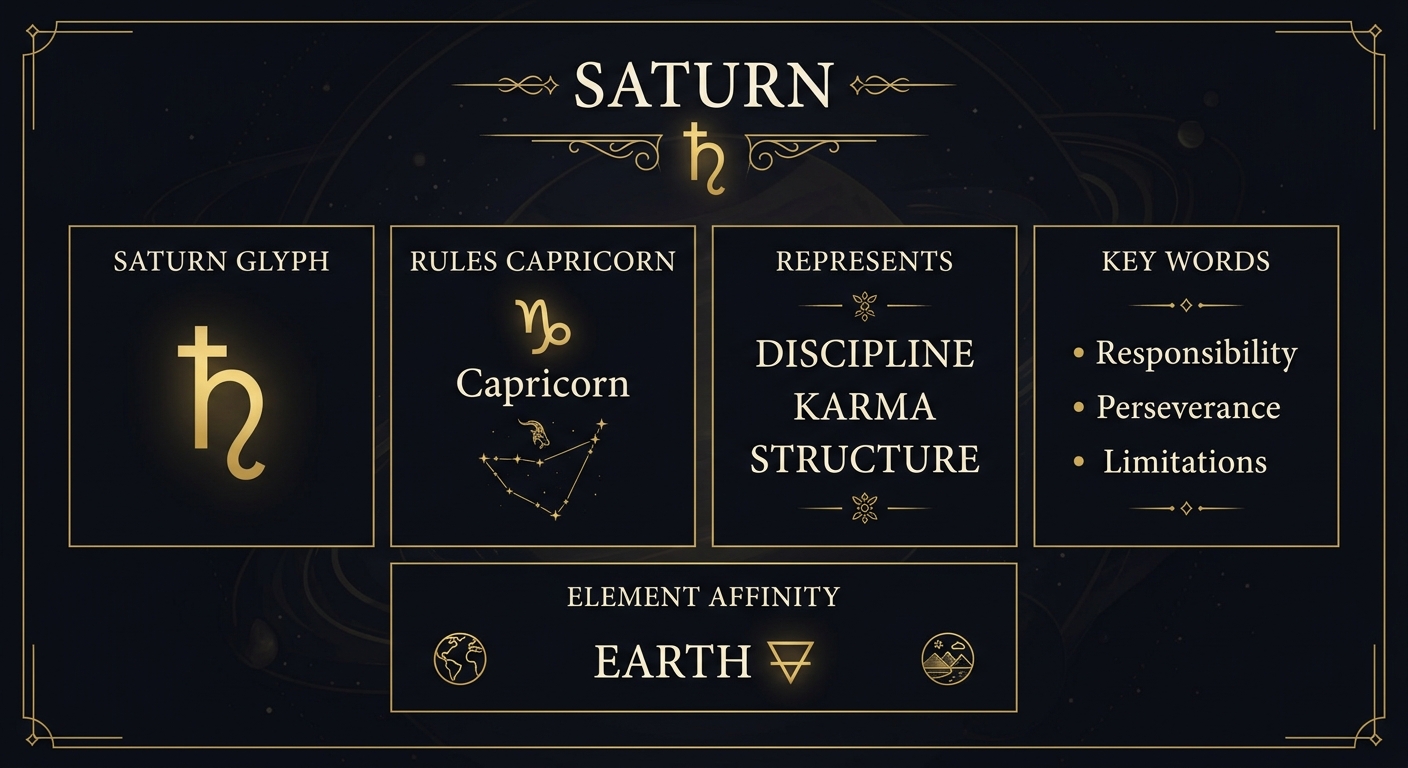
Saturn is the planet of structure, limitation, and mastery. In Cancer, its detriment, it demands emotional self-sufficiency — the ability to feel safe, nourished, and rooted even when external circumstances are cold, unstable, or indifferent to your needs.
Saturn in detriment means the planet's lessons arrive in their most uncomfortable form. Cancer wants emotional warmth, family closeness, and the security of belonging. Saturn restricts all of these — often through early experiences of emotional distance, family disruption, or a home environment where vulnerability was dangerous rather than welcomed.
The demand is not to become hard or emotionally numb. That's the failure mode, not the lesson. The demand is to become your own emotional anchor — to develop the internal stability that Cancer normally seeks from family, tradition, and belonging. You must learn to mother yourself before you can effectively nurture anyone else.
This placement tests your relationship with the past. Saturn in Cancer may burden you with family karma, ancestral patterns, or a complicated relationship with your homeland or heritage. The work is not to reject these roots but to sort through them with maturity — keeping what serves you, releasing what doesn't, and building a sense of home that you carry with you rather than one that depends on an address.
Saturn in Cancer: The Life Lesson
The central lesson of Saturn in Cancer is that emotional safety is something you build, not something you find. No partner, no family, no house will ever make you feel fully secure until you've done the internal construction work that Saturn demands.
Early life almost always features some form of emotional restriction — a distant parent, a family that didn't express feelings, moves that disrupted your sense of home, or responsibilities that forced you to grow up before you were ready. You may have been the child who took care of the family rather than being taken care of by it.
Career lessons often center around creating environments of safety and structure for others — precisely because you know what it's like to grow up without them. Many people with Saturn in Cancer become excellent managers, therapists, real estate professionals, or institutional builders because they understand, intimately, what it takes to make a space feel secure.
The relationship with food, body, and domestic life is part of the curriculum. Saturn in Cancer may restrict your appetite (emotional or physical), complicate your relationship with cooking or homemaking, or create anxiety around domestic stability. The mature expression is developing reliable, nourishing routines — not from compulsion but from genuine self-care that you had to learn because it wasn't modeled for you.
Famous Saturn in Cancer Examples
Princess Diana had Saturn in Cancer and lived the placement's central tension publicly — yearning for emotional warmth and family closeness within an institution designed to suppress both. Her emotional authenticity, forged through that deprivation, became the very thing that made her the most beloved royal of her generation.
Kurt Cobain carried this placement, and his music was the sound of Saturn in Cancer — raw emotional need expressed through a wall of distortion, the desperate search for home and belonging rendered in three chords and a scream. The restriction of early family life became the fuel for art that spoke to an entire generation's disconnection.
Barack Obama has Saturn in Cancer, raised without his father, moved repeatedly as a child, and navigated the complexity of a multiracial identity in a nation that wanted simple categories. His political career — building coalitions, creating belonging across difference — is the mature expression of a placement that knows what it means to construct a sense of home from scratch.
J.K. Rowling had Saturn in Cancer and wrote the most beloved orphan story of the modern era. Harry Potter is Saturn in Cancer's dream: a child deprived of family who builds his own, a boy locked under the stairs who discovers he belongs to a world of magic. The restriction became the creative wellspring.
Your Saturn in Cancer
A 2-3 sentence reading drawn from your actual chart data, generated once and saved to your profile.
Saturn Through the 6 Systems
How each ancient system sees this archetype
Structure, limitation, and time. Saturn is the principle of gravity — the architect of boundary, the initiator of maturity, the teacher whose lessons cannot be rushed.
Shani — tamasic lord of karma, the great leveler. Ruler of Capricorn and Aquarius, exalted in Libra. Governs Sade Sati, discipline, elders, and the long arc of karmic consequence.
Saturn in Human Design represents the corrective authority — the gates that test your Design for authenticity. Saturn transits mark the conditioning that must be dissolved for aura clarity.
In the 64 Archetypes framework, Saturn's hexagrams hold the core challenge — the primary shadow pattern (often inherited through the father's lineage) that must be faced for individuation.
Saturn resonates with the Spade suit at its most disciplined — marking the cards that describe karmic lessons, the structures built for the long haul, and the domains that demand time.
Saturn resonates with the number 8 (worldly mastery, karma) and with Life Path 4 at its most disciplined. The principle of tested structure.
Frequently Asked Questions
- What does Saturn's sign reveal in a birth chart?
- Saturn's sign describes where you face your most persistent challenges, where you are asked to develop mastery through sustained effort, and where early limitation eventually becomes hard-won authority. It is the area of life that demands the most from you — and rewards you most deeply when you meet that demand.
- How does Saturn sign affect discipline and responsibility?
- Saturn's sign shapes the specific domain where you feel the weight of responsibility most acutely. It is where you tend toward self-doubt early in life and where you develop genuine competence only through real reckoning with your own limits.
- What is the Saturn return and when does it happen?
- The Saturn return occurs at approximately ages 29–30, 58–59, and 88–89, when Saturn returns to the sign and degree it occupied at your birth. It is traditionally a period of reckoning — structures that were not built on solid ground tend to fall, and what remains becomes the foundation for the next chapter.
- Does Saturn sign indicate where we feel most restricted?
- Yes — Saturn's sign often describes an area of life where you feel an early sense of inadequacy, fear, or heaviness. These are not permanent limitations; they are the specific curriculum Saturn assigns you. Mastery in that sign's domain is entirely possible, but it requires patience and honest effort.