The Generational Signature: 1988–1996
Uranus entered Capricorn in 1988 and remained through 1996. The Soviet Union dissolved in 1991—the single most dramatic institutional collapse of the twentieth century. Apartheid ended in South Africa. The European Union formalized with the Maastricht Treaty. Old power structures fell; new ones struggled to take shape.
The internet went commercial during this transit. The World Wide Web launched in 1991; Netscape shipped in 1994. This was not just a technology—it was a direct challenge to Capricornian hierarchy. Information, which had always flowed down from authority to citizen, could now flow in every direction. The gatekeepers lost their gates.
Corporate restructuring defined the business landscape. Downsizing, outsourcing, and the first wave of globalization dismantled the old social contract between employer and employee. The generation born under this transit never knew a world where you worked at one company for 40 years and retired with a pension. They were born into institutional instability, and they learned early to build their own structures rather than trust inherited ones.
Uranus in Capricorn in Your Birth Chart
Natal Uranus in Capricorn gives you an unusual relationship with authority: you respect structure, but only structure that has earned its place. The house placement shows where you build unconventional systems. In the 10th house (Capricorn’s natural domain), your career path looks nothing like your parents’ expectations—you may found organizations, restructure existing ones, or leave corporate life entirely to build something that works on your terms.
In the 4th house, your family structure is unconventional, and you may serve as the one who breaks family patterns that have persisted for generations. In the 6th house, your daily work life resists routine—you need structure, but it must be structure you designed yourself.
Saturn rules Capricorn, so Saturn aspects to natal Uranus here define the tension between discipline and disruption in your life. A conjunction (which occurred during this transit) creates a person who can dismantle an institution and rebuild a better one—simultaneously destructive and constructive. A square to Saturn produces friction between the urge to rebel and the need for stability, often resolved only by becoming your own authority.
Historical Cycles and What Comes Next
The prior Uranus-in-Capricorn transit (1904–1912) saw the first Russian Revolution (1905), the founding of the FBI, and the breakup of Standard Oil—each a restructuring of institutional power. The Chinese revolution of 1911 ended two thousand years of imperial rule. When Uranus enters Capricorn, empires either reform or fall.
Before that, the 1821–1828 transit coincided with the Monroe Doctrine (redefining American geopolitical authority) and the independence of Greece from the Ottoman Empire. The pattern is consistent: authority structures that have calcified beyond usefulness get shattered and rebuilt.
The next Uranus-in-Capricorn transit arrives around 2072–2079. Until then, the generation born under this placement carries forward its essential question: which structures deserve to stand, and which are just habits dressed up as necessity? Your chart shows where you are doing that work—testing institutions, building new ones, and refusing to bow to authority that cannot justify itself.
Your Uranus in Capricorn
A 2-3 sentence reading drawn from your actual chart data, generated once and saved to your profile.
Uranus Through the 6 Systems
How each ancient system sees this archetype
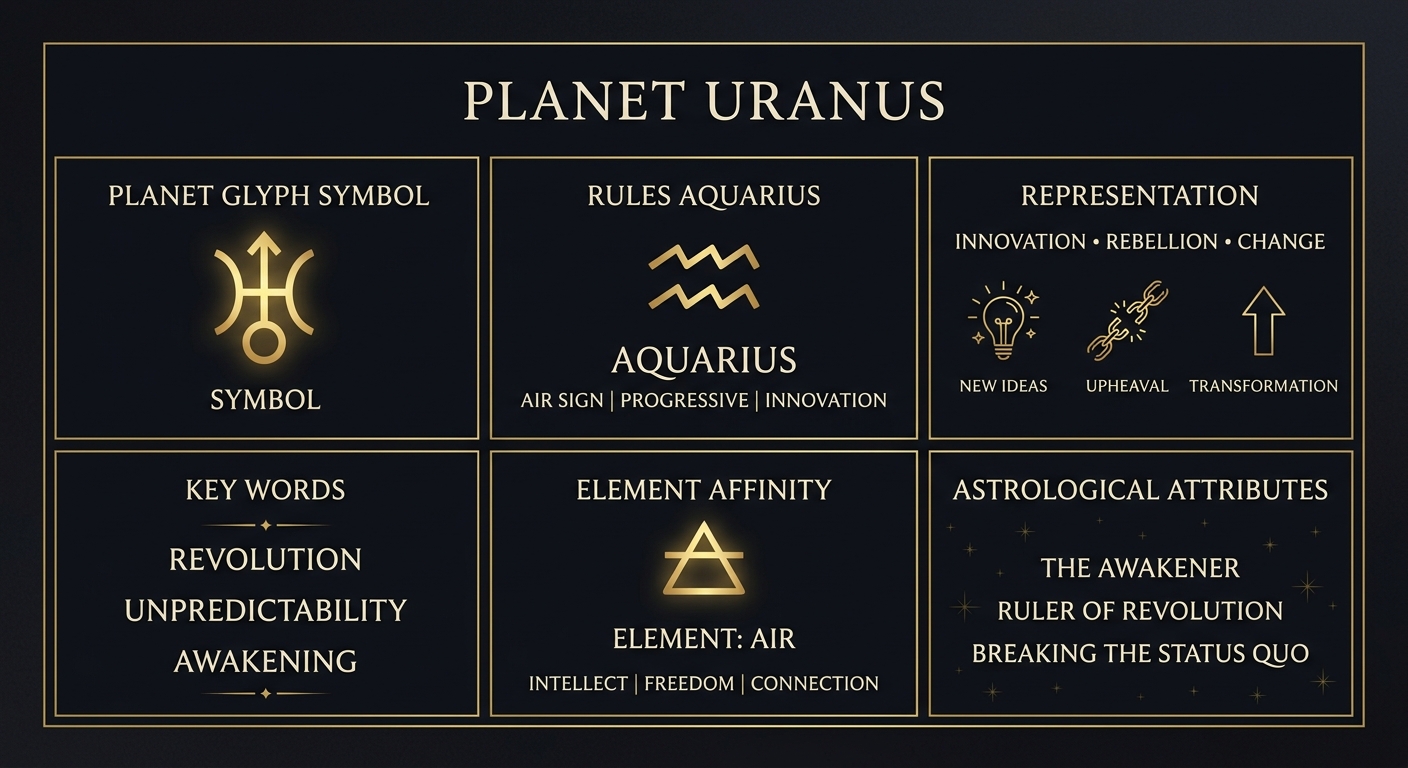
Disruption, individuation, and awakening. Uranus is the lightning strike — the shock that liberates you from who you were told to be and returns you to your authentic frequency.
Traditional Jyotish does not use Uranus; its themes are carried by Rahu (the North Node) — the shadow graha of obsessive innovation, foreign influence, and paradigm rupture.
Uranus carries a 7-year cycle in Human Design — its transits through a sign mark generational awakening themes and the collective individuation pulse of each cohort.
In the 64 Archetypes framework, Uranus' generational hexagram carries the awakening current — the somatic threshold at which the authentic self breaks through inherited conditioning.
Uranus appears in the long-cycle movement rather than the weekly card rotation — its passage through a sign marks the 7-year inflection points when the life's spread visibly rearranges.
Uranus resonates with Master Number 11 (sudden illumination) and with the number 4 inverted — structure collapsing to reveal the genius beneath convention.
Frequently Asked Questions
- What does Uranus's sign reveal in a birth chart?
- Uranus's sign describes the generational frequency of disruption and innovation you were born into. Natally, its house position and aspects to personal planets reveal where that collective urge for freedom and radical change manifests most personally in your life.
- How does Uranus sign affect innovation and rebellion?
- Uranus's sign colors the style and domain of the generation's urge to break with the past. In your personal chart, Uranus aspects show where you carry that impulse most acutely — where you resist convention, crave originality, and are prone to sudden, irreversible change.
- How long does Uranus stay in each sign?
- Uranus spends approximately seven years in each zodiac sign, taking 84 years to complete a full cycle. Because of this, it functions primarily as a generational planet — but its house placement and aspects to personal planets make it deeply individual in your chart.
- What does a Uranus return mean?
- A Uranus return — when Uranus completes its 84-year cycle and returns to its natal position — is rarely lived in full. The Uranus half-return at around age 42 is more commonly experienced: a jolt of mid-life disruption where the unlived parts of your chart demand expression.