The Generational Signature: 1968–1975
Uranus entered Libra in 1968 and remained through 1975. No-fault divorce became law during this transit, fundamentally changing the legal structure of marriage. The women’s liberation movement challenged every assumption about partnership roles. The Equal Rights Amendment passed Congress in 1972. Roe v. Wade was decided in 1973. Each of these events restructured the relationship between individuals—particularly between men and women—in ways that are still reverberating.
Internationally, détente between the US and Soviet Union represented a Libran attempt at diplomatic balance, accomplished through Uranian unconventionality—Nixon going to China was the geopolitical equivalent of a no-fault divorce from Cold War absolutism. The generation born during this transit inherited an instinct for finding balance through disruption rather than compromise.
The art world reflected the transit precisely. Conceptual art challenged whether beauty was even the point. Glam rock played with gender presentation. The very categories that Libra traditionally sorts—masculine/feminine, beautiful/ugly, just/unjust—were thrown into the air and caught in new configurations.
Uranus in Libra in Your Birth Chart
Natal Uranus in Libra creates a paradox at the center of your relational life: you need partnership, and you need it to be radically different from the partnerships you grew up watching. The house placement shows where this paradox plays out. In the 7th house, you attract partners who are themselves unconventional, or you insist on relationship structures—open, long-distance, deeply egalitarian—that would have been unthinkable a generation earlier.
In the 1st house, you project an air of fairness that hides a revolutionary streak. People assume you are the diplomat; they discover you are the one who overturns the table when the negotiation is rigged. In the 4th house, your home life runs on principles of equality that you enforce with surprising intensity.
Venus aspects to Uranus in Libra define the texture of your love life. A conjunction draws you to people who are striking, unusual, and impossible to categorize. A square can produce a pattern of sudden attractions and equally sudden departures—not because you are fickle, but because you recognize incompatibility faster than most people and refuse to pretend otherwise.
Historical Cycles and What Comes Next
The previous Uranus-in-Libra cycle (1884–1891) coincided with the founding of the suffragette movement in multiple countries and the early labor union movement’s push for fair working contracts. The Haymarket affair of 1886 was a Uranus-in-Libra event—a demand for justice that turned explosive. Each cycle forces the question: is balance possible without upheaval?
The next Uranus-in-Libra transit arrives around 2053–2059. Given current trends in relationship structures, gender identity, and legal frameworks for partnership, that generation will likely operate with definitions of relationship and justice that are unrecognizable to us now.
If you carry Uranus in Libra natally, you have already spent your life testing the limits of partnership and fairness. Your chart shows which house hosts that experiment and which aspects give it its specific flavor. Understanding this placement helps you stop apologizing for wanting relationships that work differently—and start building them with intention.
Your Uranus in Libra
A 2-3 sentence reading drawn from your actual chart data, generated once and saved to your profile.
Uranus Through the 6 Systems
How each ancient system sees this archetype
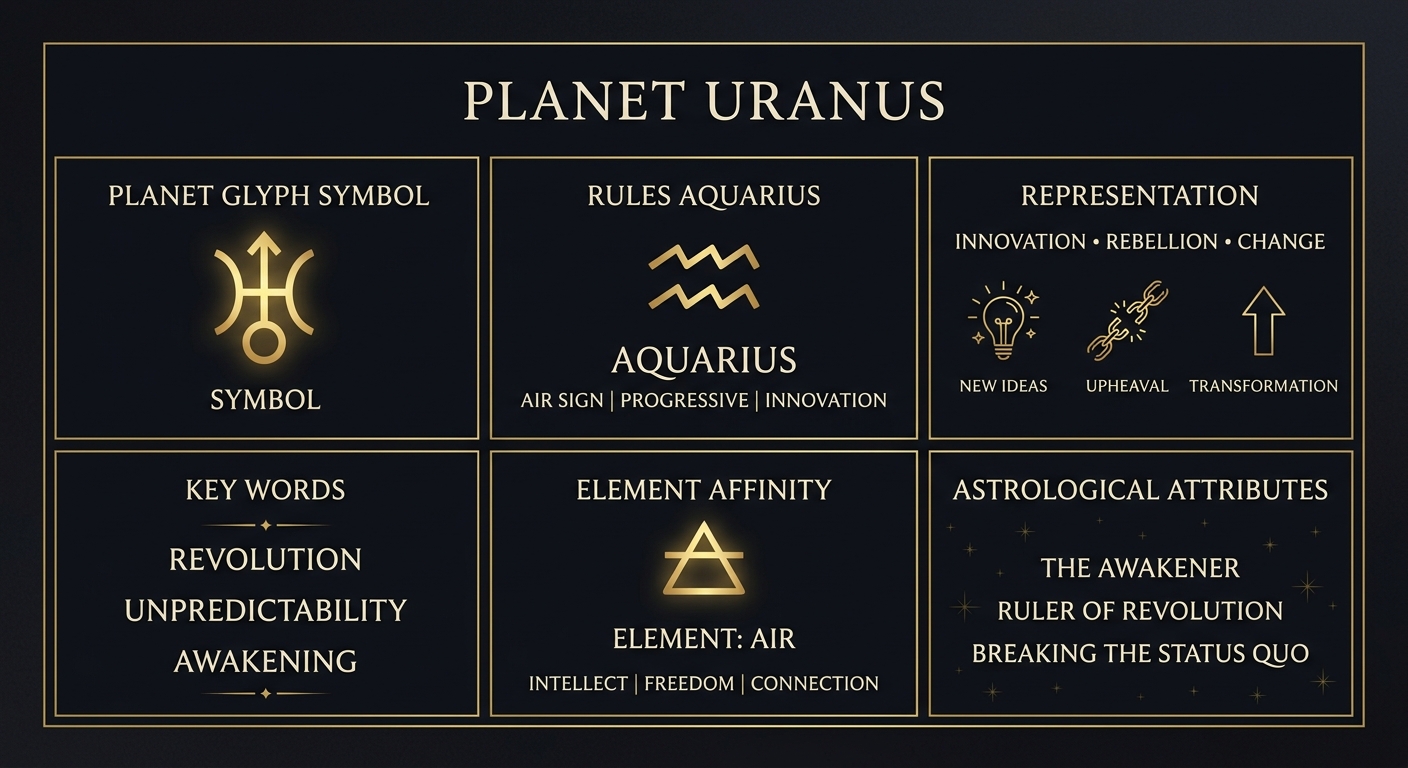
Disruption, individuation, and awakening. Uranus is the lightning strike — the shock that liberates you from who you were told to be and returns you to your authentic frequency.
Traditional Jyotish does not use Uranus; its themes are carried by Rahu (the North Node) — the shadow graha of obsessive innovation, foreign influence, and paradigm rupture.
Uranus carries a 7-year cycle in Human Design — its transits through a sign mark generational awakening themes and the collective individuation pulse of each cohort.
In the 64 Archetypes framework, Uranus' generational hexagram carries the awakening current — the somatic threshold at which the authentic self breaks through inherited conditioning.
Uranus appears in the long-cycle movement rather than the weekly card rotation — its passage through a sign marks the 7-year inflection points when the life's spread visibly rearranges.
Uranus resonates with Master Number 11 (sudden illumination) and with the number 4 inverted — structure collapsing to reveal the genius beneath convention.
Frequently Asked Questions
- What does Uranus's sign reveal in a birth chart?
- Uranus's sign describes the generational frequency of disruption and innovation you were born into. Natally, its house position and aspects to personal planets reveal where that collective urge for freedom and radical change manifests most personally in your life.
- How does Uranus sign affect innovation and rebellion?
- Uranus's sign colors the style and domain of the generation's urge to break with the past. In your personal chart, Uranus aspects show where you carry that impulse most acutely — where you resist convention, crave originality, and are prone to sudden, irreversible change.
- How long does Uranus stay in each sign?
- Uranus spends approximately seven years in each zodiac sign, taking 84 years to complete a full cycle. Because of this, it functions primarily as a generational planet — but its house placement and aspects to personal planets make it deeply individual in your chart.
- What does a Uranus return mean?
- A Uranus return — when Uranus completes its 84-year cycle and returns to its natal position — is rarely lived in full. The Uranus half-return at around age 42 is more commonly experienced: a jolt of mid-life disruption where the unlived parts of your chart demand expression.