The Generational Signature: 1901–1915
Neptune entered Cancer at the turn of the 20th century and stayed through 1915. This was the era of peak nationalism in Europe—not the cynical, strategic nationalism of politicians, but the romantic, emotional nationalism of ordinary people who genuinely believed their country was sacred. Cancer rules the motherland, and Neptune made that attachment transcendent, quasi-religious, worth dying for.
Domestically, this transit produced the Arts and Crafts movement and the idealization of the handmade home. William Morris’s vision of beautiful, individually crafted interiors was a Neptunian fantasy of Cancer’s domain—the home as sanctuary, as spiritual refuge from industrial modernity. The generation born under this placement grew up believing that home was not just a place but a feeling, and that feeling was worth protecting at any cost.
The shadow side emerged when that protective instinct curdled into xenophobia. If home is sacred, then anyone who threatens it becomes profane. Immigration restrictions tightened across the Western world during and after this transit. The line between “protecting our way of life” and “fearing the outsider” dissolved—exactly as Neptune dissolves all lines.
Neptune in Cancer in Your Birth Chart
With Neptune in Cancer in your natal chart, the house placement shows where your emotional foundations are most permeable. In the 4th house (Cancer’s natural home), your relationship with family and physical home carries a dreamy, idealized quality—you may remember childhood as more magical than it was, or feel perpetually homesick for a place that exists more in feeling than in fact. In the 12th house, your unconscious is deeply tied to ancestral patterns; you carry emotional residue from family lines you may not fully understand.
Aspects to the Moon (Cancer’s ruler) are decisive. Neptune conjunct the Moon produces profound emotional sensitivity—you absorb the moods of everyone around you like a sponge, which makes you deeply empathetic but also vulnerable to emotional overwhelm. A square from Neptune to the Moon can indicate a mother figure who was either idealized or elusive, leaving you searching for a sense of nurturing that always seems just out of reach.
The generational theme—idealizing home and roots—becomes personal through house placement. Neptune in Cancer in the 7th house dissolves boundaries in marriage and partnership, often through caretaking dynamics. In the 2nd house, emotional security and financial security become intertwined in ways that are hard to untangle. Your chart shows precisely where the fog settles over your emotional foundations.
Historical Cycles and Cultural Legacy
The Neptune-in-Cancer transit before the 20th century (roughly 1737–1751) coincided with the early stirrings of what would become American identity—the Great Awakening, the first pan-colonial religious movement, gave scattered settlers a shared emotional and spiritual vocabulary. The idea of “home” was expanding from a physical house to an imagined community, and Neptune dissolved the borders between local and national belonging.
Further back, the transit around 1574–1588 overlapped with the height of Elizabethan England’s self-mythologizing. The cult of the Virgin Queen turned Elizabeth I into a living symbol of the nation—motherhood and monarchy fused into a single Neptunian image. The defeat of the Spanish Armada in 1588 cemented a national origin story that England would retell for centuries.
The next Neptune-in-Cancer transit arrives around 2065–2078. By then, the meaning of “home” may have shifted radically—virtual communities, climate migration, and post-national identities could redefine what Cancer’s domain even means. The generation born under that placement will carry an instinct for emotional belonging that transcends geography. Your current chart reveals where Neptune’s Cancerian fog already operates in your life and where your own concept of home deserves honest examination.
Your Neptune in Cancer
A 2-3 sentence reading drawn from your actual chart data, generated once and saved to your profile.
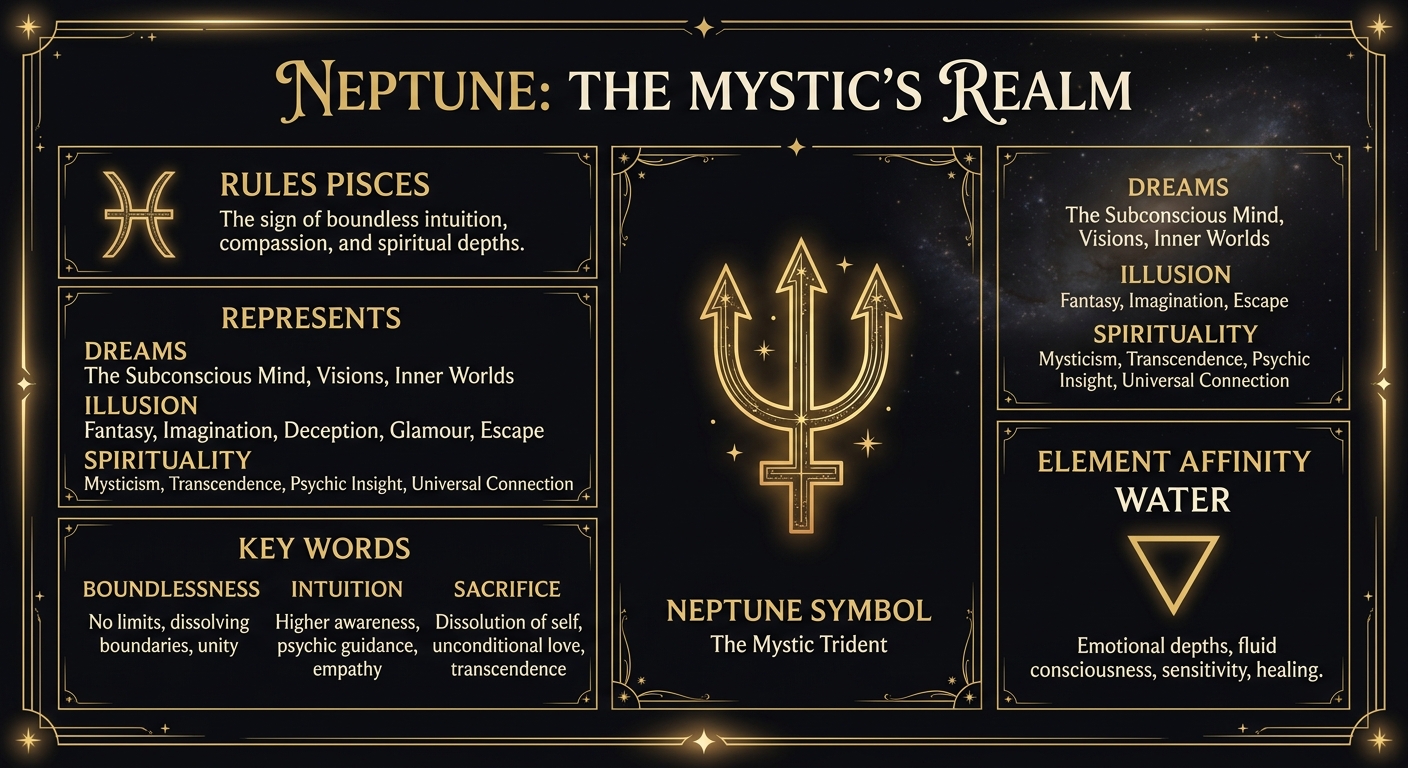
Neptune Through the 6 Systems
How each ancient system sees this archetype
Dissolution, imagination, and the transpersonal. Neptune is the solvent — the principle that thins the boundary between self and source, and opens the artist's and mystic's channels.
Traditional Jyotish attributes Neptune's themes to Ketu (the South Node) — the dissolving graha of moksha, spiritual surrender, and the falling-away of worldly identity.
Neptune moves slowly through the bodygraph; its generational transits carry the collective fog-and-awakening themes that each cohort must see through for real clarity.
In the 64 Archetypes framework, Neptune's generational hexagram carries the dissolving current — the subtle-body layer where individual pattern meets the transpersonal field.
Neptune in Cardology shows up in the deep cycle spreads — the slow tides that shape a generation's romantic ideals, spiritual longings, and creative myths.
Neptune resonates with Master Number 22 (the Master Builder of the unseen) and with Life Path 7 at its most mystical. The principle of transcendent imagination.
Frequently Asked Questions
- What does Neptune's sign reveal in a birth chart?
- Neptune's sign describes the collective ideals, illusions, and spiritual currents of your generation. In your personal chart, Neptune's house and aspects to personal planets reveal where you are most susceptible to dissolving boundaries — and where your intuition and imagination are deepest.
- How does Neptune sign affect intuition and imagination?
- Neptune dissolves the sharp edges of whatever it touches, opening space for imagination, empathy, and spiritual perception. Its sign describes the domain where your generation sought transcendence — and where you personally are most capable of profound sensitivity and most vulnerable to self-deception.
- How long does Neptune stay in each sign?
- Neptune spends approximately fourteen years in each zodiac sign, taking roughly 165 years to complete a full cycle. No living person experiences a Neptune return, which is why it operates almost entirely as a generational signature — made personal only through house placement and aspects.
- Does Neptune sign affect spiritual development?
- Neptune's sign describes the style and framework through which your generation pursues spiritual experience. Whether that takes the form of religious devotion, artistic transcendence, psychedelic exploration, or collective compassion depends on the sign — and on the rest of your chart.