The Generational Signature: 1887–1901
Neptune entered Gemini during the golden age of newspapers—and promptly dissolved any pretense of journalistic objectivity. William Randolph Hearst and Joseph Pulitzer turned news into narrative, fabricating stories to sell papers and, in the case of the Spanish-American War, to start an actual conflict. “You furnish the pictures, I’ll furnish the war” is Neptune in Gemini distilled to a single sentence.
This was also the era when spiritualism reached peak cultural influence. The Fox sisters, the Theosophical Society, and countless mediums claimed to channel messages from the dead—communication (Gemini) with the invisible world (Neptune). Some were frauds. Some were sincere. The generation born under this transit could not always tell the difference, and that ambiguity was the point.
The positive expression of Neptune in Gemini produced writers of extraordinary imaginative power. Arthur Conan Doyle created Sherlock Holmes during these years—a character obsessed with rational deduction, invented by an author who believed in fairies. That paradox captures the transit perfectly: the mind reaches for clarity while swimming in fog.
Neptune in Gemini in Your Birth Chart
If Neptune in Gemini appears in your natal chart, the house it occupies reveals where your thinking turns intuitive, poetic, and occasionally unreliable. In the 3rd house (Gemini’s natural domain), you communicate with unusual sensitivity—picking up on what people mean rather than what they say—but you may also mishear, misquote, or fill in gaps with imagination. In the 9th house, your philosophical and spiritual beliefs are unusually fluid; you absorb ideas from everywhere and synthesize them into something entirely your own.
Aspects to Mercury (Gemini’s ruler) define how this plays out in daily life. Neptune conjunct Mercury gives a mind that thinks in images and metaphors—ideal for poetry, music, and film, but challenging for tasks that require precision and literal accuracy. A square between Neptune and Mercury can indicate a pattern of hearing what you want to hear, or a susceptibility to persuasive but misleading information.
Two people with natal Neptune in Gemini will share a generational tendency toward imaginative thinking, but the one with Neptune in the 6th house experiences it through daily work routines (perhaps a healthcare worker with uncanny diagnostic intuition), while the one with Neptune in the 11th dissolves boundaries within friend groups and communities. The house makes it specific to your life.
Historical Patterns and Future Implications
The Neptune-in-Gemini cycle prior to the 1887 transit (roughly 1723–1737) coincided with the explosion of coffeehouses as information hubs, the rise of satirical pamphlets, and Jonathan Swift’s most biting works. Print culture was democratizing information, but it was also democratizing misinformation. Fake news is not a 21st-century invention; it resurfaces every time Neptune visits Gemini.
The transit around 1560–1574 overlapped with the early years of the printing press’s cultural dominance, when forged documents and fabricated histories circulated alongside genuine scholarship. The Catholic Church and Protestant reformers each accused the other of spreading lies—and both were right. Neptune in Gemini does not pick sides; it dissolves the framework that makes “sides” legible.
The next Neptune-in-Gemini period (approximately 2051–2065) will arrive in a world already saturated with AI-generated text, deepfaked voices, and synthetic media. The question this generation will face is not whether information can be trusted, but whether the concept of “trust” still applies to communication at all. Your chart shows which house hosts this dissolution—and where your own relationship with truth needs the sharpest discernment.
Your Neptune in Gemini
A 2-3 sentence reading drawn from your actual chart data, generated once and saved to your profile.
Neptune Through the 6 Systems
How each ancient system sees this archetype
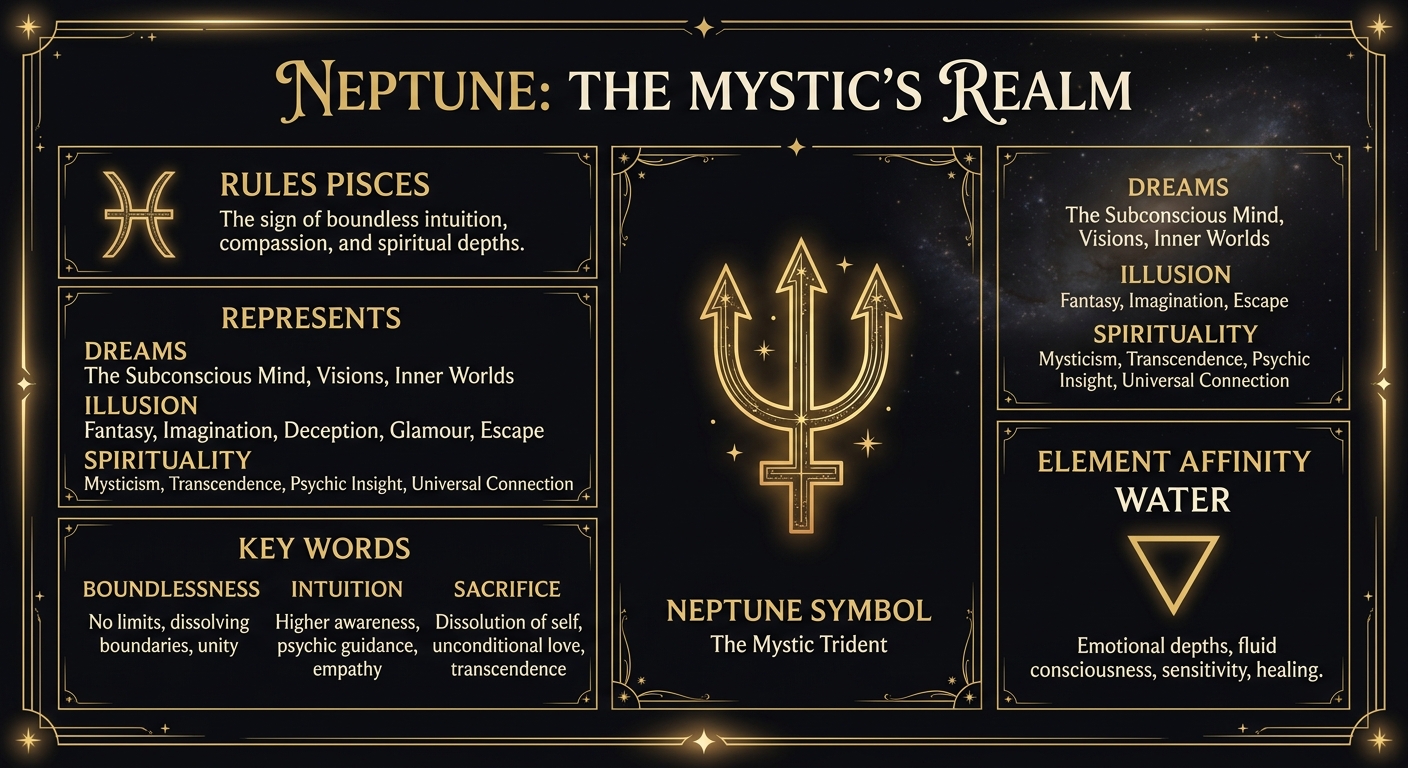
Dissolution, imagination, and the transpersonal. Neptune is the solvent — the principle that thins the boundary between self and source, and opens the artist's and mystic's channels.
Traditional Jyotish attributes Neptune's themes to Ketu (the South Node) — the dissolving graha of moksha, spiritual surrender, and the falling-away of worldly identity.
Neptune moves slowly through the bodygraph; its generational transits carry the collective fog-and-awakening themes that each cohort must see through for real clarity.
In the 64 Archetypes framework, Neptune's generational hexagram carries the dissolving current — the subtle-body layer where individual pattern meets the transpersonal field.
Neptune in Cardology shows up in the deep cycle spreads — the slow tides that shape a generation's romantic ideals, spiritual longings, and creative myths.
Neptune resonates with Master Number 22 (the Master Builder of the unseen) and with Life Path 7 at its most mystical. The principle of transcendent imagination.
Frequently Asked Questions
- What does Neptune's sign reveal in a birth chart?
- Neptune's sign describes the collective ideals, illusions, and spiritual currents of your generation. In your personal chart, Neptune's house and aspects to personal planets reveal where you are most susceptible to dissolving boundaries — and where your intuition and imagination are deepest.
- How does Neptune sign affect intuition and imagination?
- Neptune dissolves the sharp edges of whatever it touches, opening space for imagination, empathy, and spiritual perception. Its sign describes the domain where your generation sought transcendence — and where you personally are most capable of profound sensitivity and most vulnerable to self-deception.
- How long does Neptune stay in each sign?
- Neptune spends approximately fourteen years in each zodiac sign, taking roughly 165 years to complete a full cycle. No living person experiences a Neptune return, which is why it operates almost entirely as a generational signature — made personal only through house placement and aspects.
- Does Neptune sign affect spiritual development?
- Neptune's sign describes the style and framework through which your generation pursues spiritual experience. Whether that takes the form of religious devotion, artistic transcendence, psychedelic exploration, or collective compassion depends on the sign — and on the rest of your chart.