
The Generational Signature: Historical Cycles
Pluto was last in Aries from 1822 to 1853. This transit coincided with the age of revolution and expansion: the Monroe Doctrine (1823) established American hemispheric dominance. The July Revolution (1830) toppled the French monarchy again. The Revolutions of 1848 swept across Europe, driven by individuals who decided the existing order had no authority over their future. The California Gold Rush (1848–1855) sent hundreds of thousands of people charging into the unknown, driven by individual ambition on a continental scale.
Before that, Pluto in Aries (1577–1607) saw the founding of the first permanent English colonies in North America, the defeat of the Spanish Armada, and the Elizabethan golden age—a period when individual daring (Drake, Raleigh, Shakespeare) reshaped the boundaries of the known world. Each cycle begins with someone refusing to accept the limits of the previous era.
The next Pluto-in-Aries transit begins approximately 2066–2095. Given Pluto’s eccentric orbit (it spends as few as 12 years in some signs and nearly 30 in others), this transit will last roughly 29 years. The generation born during that window will redefine individual power in a world of AI, genetic engineering, and possibly off-planet habitation—and they will do it with a ferocity that makes our current disruptions look gentle.
Pluto in Aries in Your Birth Chart
No one currently alive has natal Pluto in Aries (the last transit ended in 1853). However, understanding this placement through historical charts and ancestral patterns reveals its signature: an almost volcanic individual will, a compulsion to start things that transform the landscape, and a relationship with personal power that is both a gift and a test.
In historical charts, the house placement shows where that transformative will concentrated. In the 1st house, the individual was the transformation—their presence alone changed whatever room, institution, or nation they entered. In the 10th house, their public life was marked by dramatic rises, falls, and rebirths—careers that looked more like mythological arcs than professional trajectories.
Mars rules Aries, so Mars aspects to Pluto in Aries determined whether that volcanic power expressed as courageous leadership or destructive domination. A trine channeled the force constructively—these were the founders, the pioneers, the ones who built from nothing. A square produced tyrants, outlaws, and revolutionaries who could not distinguish between fighting for freedom and fighting for power.
What Pluto in Aries Means for Your Chart Today
Even though Pluto is not currently in Aries, every chart has Aries somewhere. The house where Aries falls in your chart is where Pluto-in-Aries themes—radical individual power, the courage to begin, the destruction of whatever blocks new life—resonate most strongly when activated by transit or progression.
If you have natal planets in Aries, Pluto’s eventual return to that sign (around 2066) will activate those placements with transformative intensity—though for most living people, this will be experienced through their children or grandchildren’s generation rather than directly.
The Pluto-in-Aries archetype is the phoenix at ignition: not the slow burn of Pluto in earth or water signs, but the explosive moment when something entirely new forces its way into existence. Understanding where Aries sits in your chart shows you where that explosive creative power waits—and what it might look like when the right transit lights the fuse.
Your Pluto in Aries
A 2-3 sentence reading drawn from your actual chart data, generated once and saved to your profile.
Pluto Through the 6 Systems
How each ancient system sees this archetype
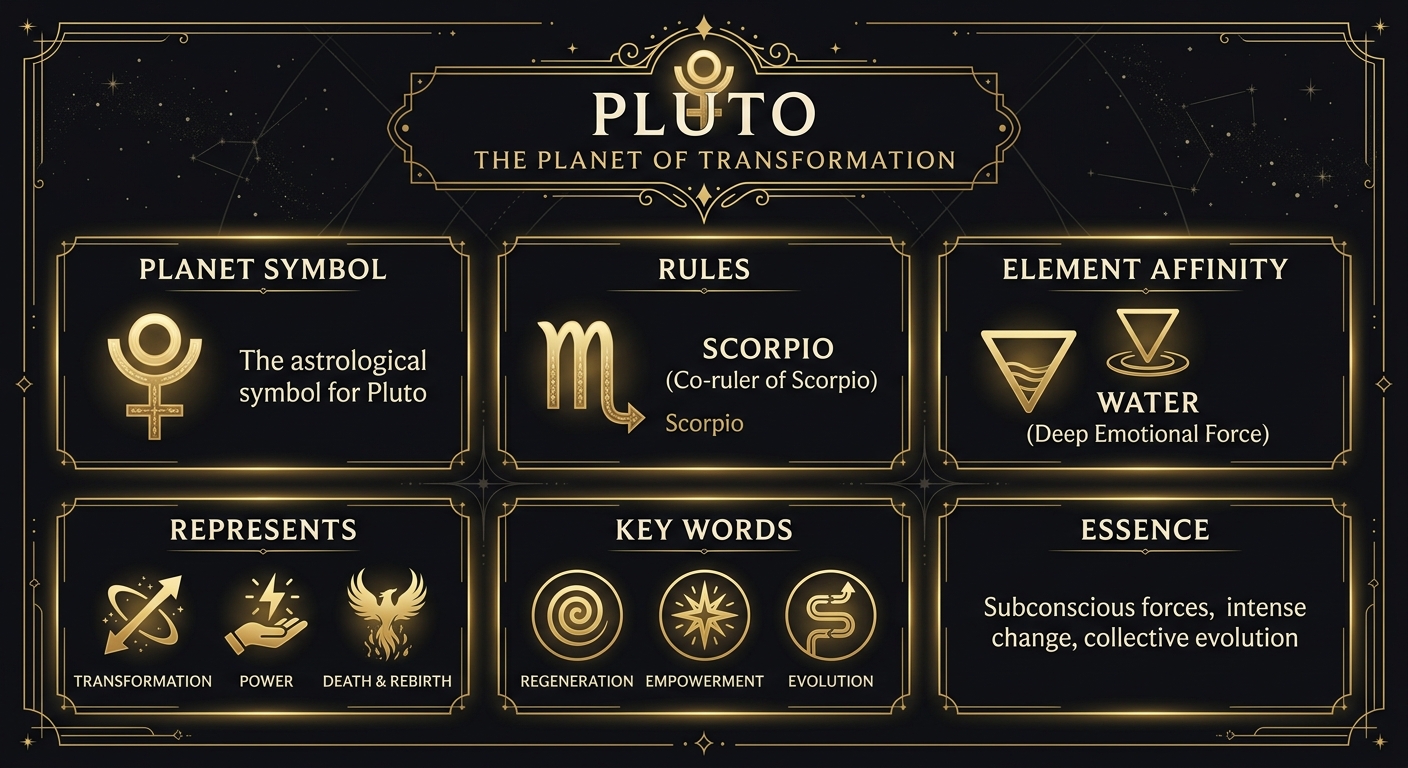
Transformation, power, and the underworld. Pluto is the generational pressure that destroys what cannot evolve — and returns what remains to a deeper, truer form.
Traditional Jyotish attributes Pluto's themes to Mangala (Mars) in its most tamasic form, and to the Rahu-Ketu axis — the karmic compulsion to transform through depth encounters.
Pluto's 12-to-30-year transits through each sign define the deepest generational conditioning. Pluto in the bodygraph marks the collective shadow themes your cohort came to transmute.
In the 64 Archetypes framework, Pluto's generational hexagram holds the deepest ancestral pattern — the transpersonal wound that eventually transfigures into collective gift.
Pluto's long transits mark the death-rebirth cycles in the lifetime spread — the moments when a card position empties out so a new configuration can emerge.
Pluto resonates with Master Number 33 (sacrificial transformation) and with the number 8 at its most alchemical. The principle of death and resurrection.
Frequently Asked Questions
- What does Pluto's sign reveal in a birth chart?
- Pluto's sign describes the generational arena of deep transformation, power struggle, and irreversible change. In your personal chart, Pluto's house and aspects reveal where that collective pressure for transformation is most personally felt — where you encounter intensity, compulsion, and the need to shed what no longer serves.
- How does Pluto sign affect transformation and power?
- Pluto's sign shows the domain where your generation dismantles and rebuilds. In personal placements, it reveals where you are capable of profound depth and regeneration — and where you are most likely to encounter control, obsession, or the kind of loss that fundamentally changes who you are.
- How long does Pluto stay in each sign?
- Pluto spends between twelve and thirty years in each zodiac sign due to its elliptical orbit, taking approximately 248 years to complete a full cycle. It is the slowest-moving planet and functions almost entirely as a generational force — except where it aspects your personal planets directly.
- What does a Pluto transit to a personal planet mean?
- When Pluto transits your natal Sun, Moon, Venus, Mars, or Mercury, it puts that part of your chart through a process of deep excavation. What felt fixed becomes subject to transformation. These transits are slow, intense, and usually irreversible in their effects — but what survives them tends to be more real than what preceded them.