
The Generational Signature: Historical Cycles
Pluto was last in Taurus from 1851 to 1884. This transit coincided with the most dramatic material transformation in human history up to that point. The Industrial Revolution reached full force, replacing human and animal labor with machine power. Railways connected continents. Telegraph wires connected hemispheres. The material basis of civilization was completely rebuilt in a single generation.
The American Civil War (1861–1865) was, beneath its moral dimensions, a Pluto-in-Taurus event: a war over who owned what—specifically, whether human beings could be treated as property. The destruction of the slave economy and the subsequent industrialization of the South represented a total transformation of material relationships that took generations to complete.
Before that, Pluto in Taurus (1607–1639) saw the founding of Jamestown and the early colonial exploitation of North American resources—the beginning of a material relationship between Europe and the New World that would reshape the global economy for centuries. Each cycle transforms not just what we have but what we believe we are entitled to possess.
Pluto in Taurus in Your Birth Chart
No one currently alive has natal Pluto in Taurus. However, the placement’s signature in historical charts is unmistakable: an obsessive, sometimes ruthless relationship with material resources. These were the industrialists, the land barons, the empire builders—people who understood that whoever controls the material foundation controls everything built upon it.
The house placement in historical charts shows where that material obsession concentrated. In the 2nd house, personal wealth became both an instrument of power and a field of transformation—fortunes built, destroyed, and rebuilt with Plutonian intensity. In the 8th house, shared resources, inheritance, and the financial dimensions of intimate relationships carried life-and-death stakes.
Venus rules Taurus, so Venus aspects to Pluto in Taurus shaped how the transformative power expressed through beauty, love, and values. A conjunction produced individuals with magnetic charisma and an ability to acquire resources that seemed almost supernatural. A square created power struggles in intimate relationships where money and desire were inseparable.
What Pluto in Taurus Means for Your Chart Today
The house where Taurus falls in your chart shows where Pluto-in-Taurus themes—total material transformation, the death and rebirth of your relationship with security—carry the most weight when activated by transits. If you have natal planets in Taurus, major Pluto aspects (squares, oppositions, conjunctions from other signs) will trigger Pluto-in-Taurus dynamics in your life: forced reassessment of what you own, what owns you, and what genuine security requires.
The next Pluto-in-Taurus transit will not arrive until approximately 2095–2128. The generation born then will face material questions we can barely formulate: post-scarcity economics, resource allocation on multiple planets, the transformation of what “property” means when matter itself can be programmed.
For now, Pluto-in-Taurus themes reach you through your chart’s Taurus house and through the ancestral patterns of your lineage—particularly if your family history includes dramatic material transformation (immigration, economic collapse, sudden wealth, or sudden loss). That history is not just background; it is active Pluto-in-Taurus material, still transforming through you.
Your Pluto in Taurus
A 2-3 sentence reading drawn from your actual chart data, generated once and saved to your profile.
Pluto Through the 6 Systems
How each ancient system sees this archetype
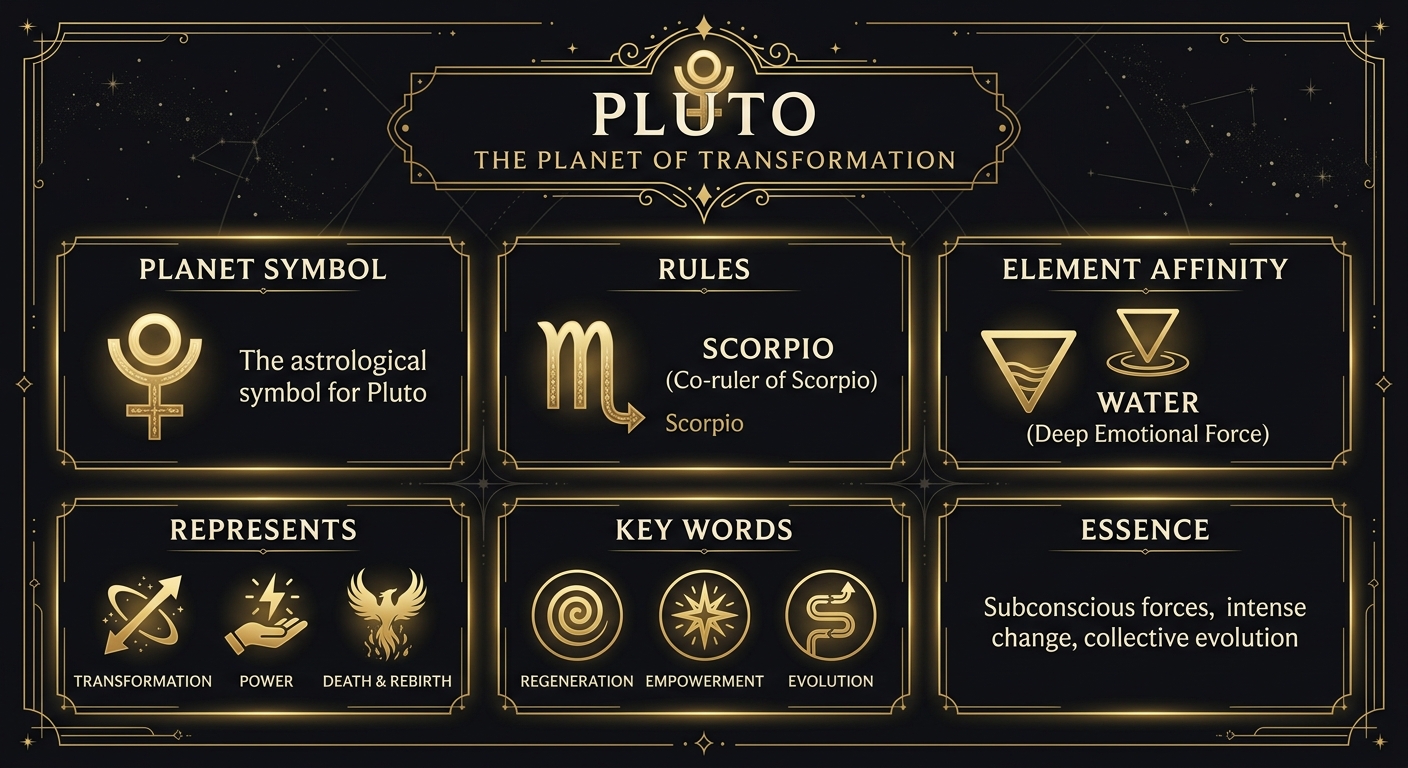
Transformation, power, and the underworld. Pluto is the generational pressure that destroys what cannot evolve — and returns what remains to a deeper, truer form.
Traditional Jyotish attributes Pluto's themes to Mangala (Mars) in its most tamasic form, and to the Rahu-Ketu axis — the karmic compulsion to transform through depth encounters.
Pluto's 12-to-30-year transits through each sign define the deepest generational conditioning. Pluto in the bodygraph marks the collective shadow themes your cohort came to transmute.
In the 64 Archetypes framework, Pluto's generational hexagram holds the deepest ancestral pattern — the transpersonal wound that eventually transfigures into collective gift.
Pluto's long transits mark the death-rebirth cycles in the lifetime spread — the moments when a card position empties out so a new configuration can emerge.
Pluto resonates with Master Number 33 (sacrificial transformation) and with the number 8 at its most alchemical. The principle of death and resurrection.
Frequently Asked Questions
- What does Pluto's sign reveal in a birth chart?
- Pluto's sign describes the generational arena of deep transformation, power struggle, and irreversible change. In your personal chart, Pluto's house and aspects reveal where that collective pressure for transformation is most personally felt — where you encounter intensity, compulsion, and the need to shed what no longer serves.
- How does Pluto sign affect transformation and power?
- Pluto's sign shows the domain where your generation dismantles and rebuilds. In personal placements, it reveals where you are capable of profound depth and regeneration — and where you are most likely to encounter control, obsession, or the kind of loss that fundamentally changes who you are.
- How long does Pluto stay in each sign?
- Pluto spends between twelve and thirty years in each zodiac sign due to its elliptical orbit, taking approximately 248 years to complete a full cycle. It is the slowest-moving planet and functions almost entirely as a generational force — except where it aspects your personal planets directly.
- What does a Pluto transit to a personal planet mean?
- When Pluto transits your natal Sun, Moon, Venus, Mars, or Mercury, it puts that part of your chart through a process of deep excavation. What felt fixed becomes subject to transformation. These transits are slow, intense, and usually irreversible in their effects — but what survives them tends to be more real than what preceded them.